Setting up IE Management
Industrial Edge Management (IEM) serves as the central infrastructure for Industrial Edge. IEM is the control plane from which the user manages devices, apps, and users of a shopfloor.
Choosing your Industrial Edge Management Offering (Operating Options)
Siemens Industrial Edge offers three IEM offerings:
- IEM Cloud: A Siemens-managed solution for quick application deployment
- IEM Virtual: Deployable as a virtual machine in your infrastructure
- IEM Pro: A fully self-contained, highly customizable setup
Consider your specific requirements for customization, deployment ease, and management preferences. Use this table as an overview of the features and use cases of each IEM offering and see which offering is most suitable for you.
| offering | Features | Use cases | Licenses |
|---|---|---|---|
| IEM Cloud | Managed solution: Siemens manages the Kubernetes infrastructure, allowing you to focus on operations efficiently without needing to manage the underlying systems. Quick Start: Enables rapid deployment and operation with minimal setup effort from the user. |
Ideal for users who prefer an out-of-the-box solution with Siemens handling the infrastructure, ensuring seamless app execution. | IEM Cloud purchased from the Marketplace. |
| IEM Virtual | Ease of deployment: Designed for easy deployment as a virtual machine using ESXi, Hyper-V and VMware Workstation. This option is convenient for users wanting a straightforward, locally hosted solution. Versatility: Can be used for initial lab testing and production scenarios, offering flexibility in how you manage your IE Devices. |
Best for scenarios prioritizing local data processing, sovereignty, or specific compliance needs. | No license required. |
| IEM Pro | Customization & independence: Offers a highly customizable setup, allowing you to tailor configurations both in the cloud and locally. Ideal for users seeking complete control over their Edge infrastructure. | Suitable for complex environments requiring detailed configurations and extensive management capabilities. | No license required. |
To set up Industrial Edge Management:
- For IEM Cloud, proceed to Setting up Industrial Edge Management Cloud.
- For IEM Virtual, proceed to Setting up Industrial Edge Management Virtual.
Browser compatibility
Industrial Edge Management is optimized for modern web browsers. Industrial Edge Management supports the latest stable version and one previous version of the following browsers:
- Google Chrome
- Mozilla Firefox
- Microsoft Edge
NOTICE
For best performance and security, Siemens recommends using the latest stable version of any supported browser.
Setting up Industrial Edge Management Cloud
IEM Cloud is an Industrial Edge Management (IEM) instance hosted on Siemens Cloud infrastructure. It provides easy setup, secure and reliable operation, and automated update services. IEM Cloud handles the underlying infrastructure and operational tasks such as setting up Kubernetes clusters and managing network topologies.
Prerequisites for IEM Cloud
- You have ordered Industrial Edge Hub Access
- You have ordered Industrial Edge Management Cloud
Theoretical Foundations
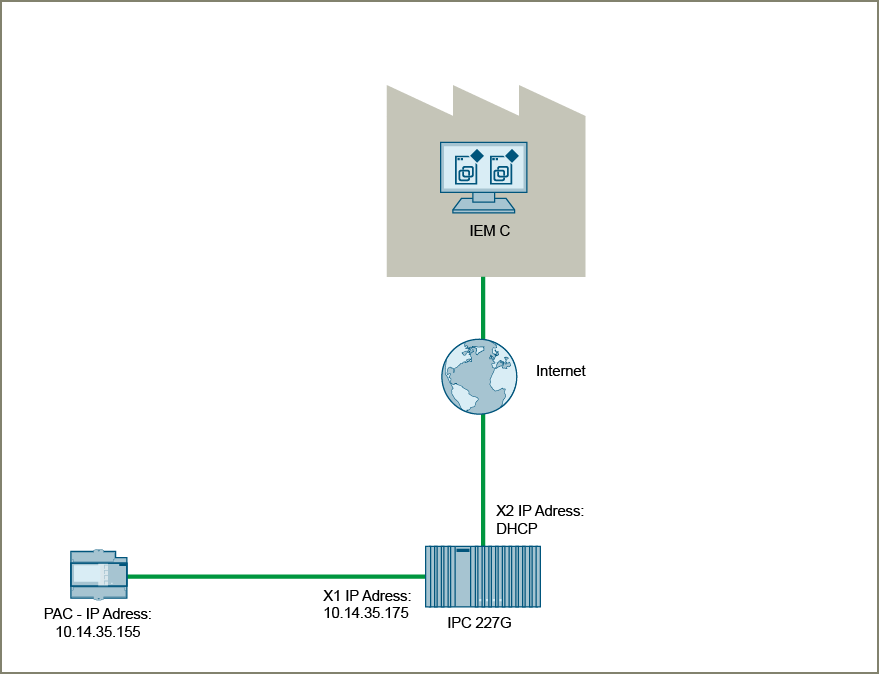
Refer to the figure below, which illustrates the Internet-based connection from the IEM to the IE Device. Communication between the IE Device and the PLC occurs over a local and protected network.
Creating an IEM Cloud instance in your IE Hub
- Open Industrial Edge Hub.
- Click "IEM instances" from the left navigation pane. The "IEM instances" page opens.
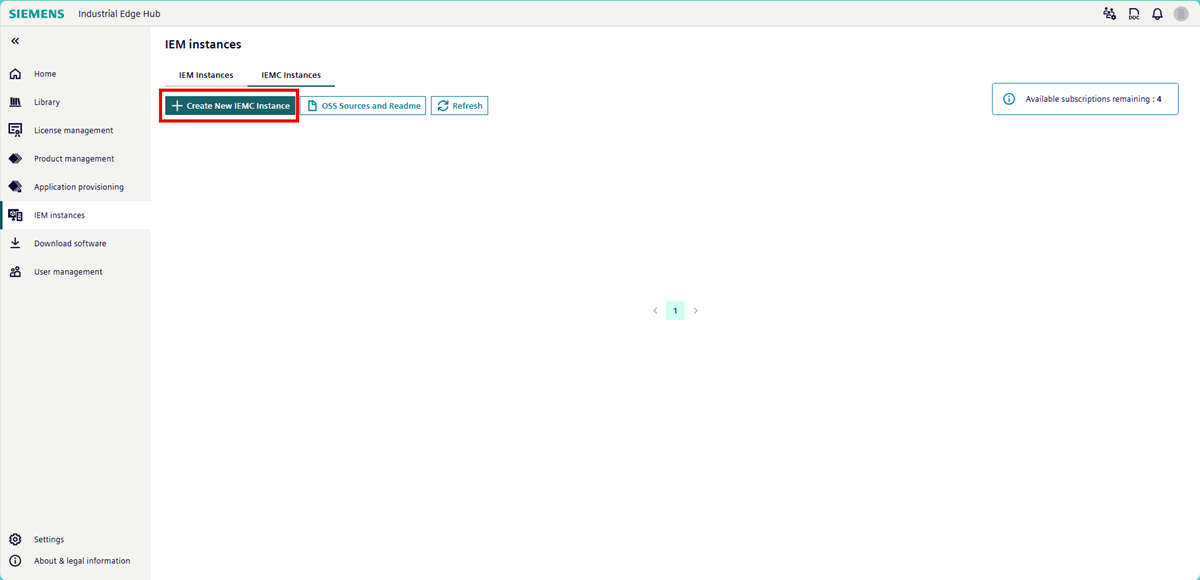
- Click "IEMC Instances". The page displays the available IEMC instances.
-
Click "Create New IEMC Instance". The "Create IEMC Instance" page opens.
-
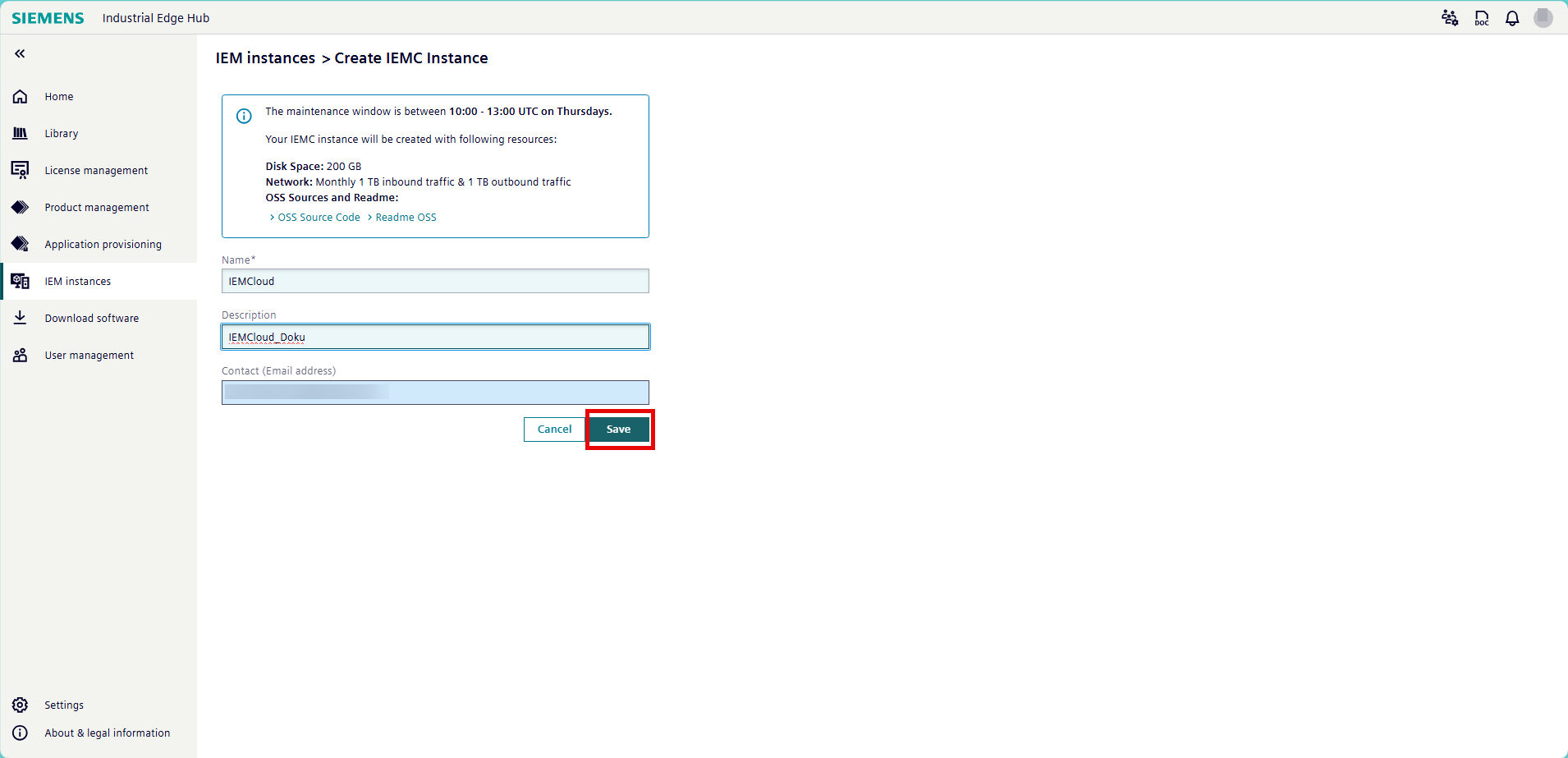
Give your IEM Cloud instance a name, a description, and an email address for the contact.
-
Click "Save". A status pop-up appears and displays the IEM Cloud instance creation process.
-
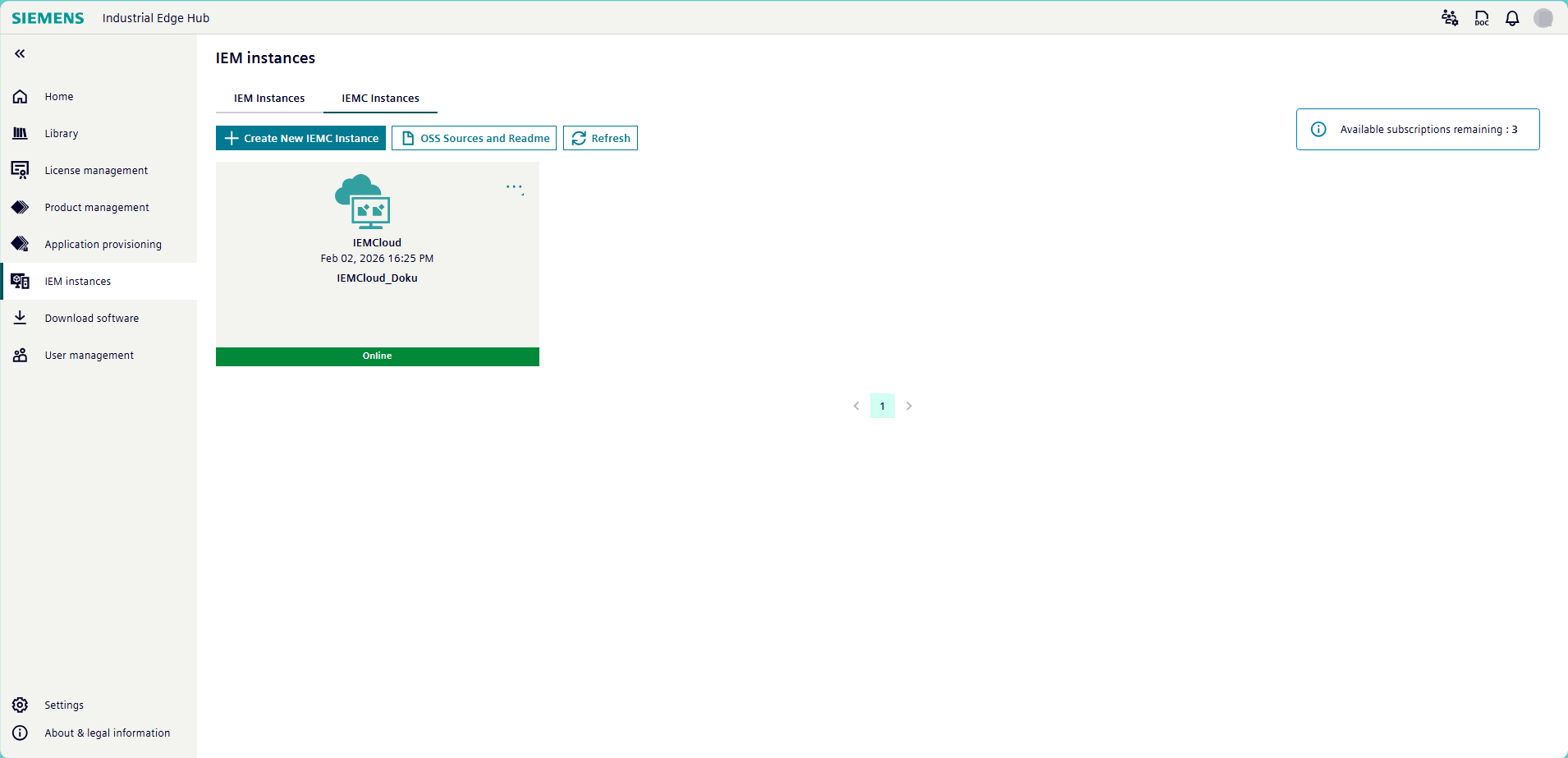
Navigate back to "IEM instances". When IE Hub finishes installing the IEM Cloud instance, its status switches from "Installing" to "Online".
Editing passwords for standard users and configuring access management
Passwords not recoverable
The initial passwords for your IEM Cloud instance can only be viewed once. Make sure to note them down correctly or store them in your password manager.
By default, the IEM Cloud instance includes two standard users called customer_admin and iem_user with temporarily assigned passwords. Set up a new password for these users and configure IEM Cloud's Identity Access Management according to the your desired settings.
- Open Industrial Edge Hub.
- Click "IEM instances" from the left navigation pane. The "IEM instances" page opens.
- Click "IEMC Instances". The page displays the available IEMC instances.
-
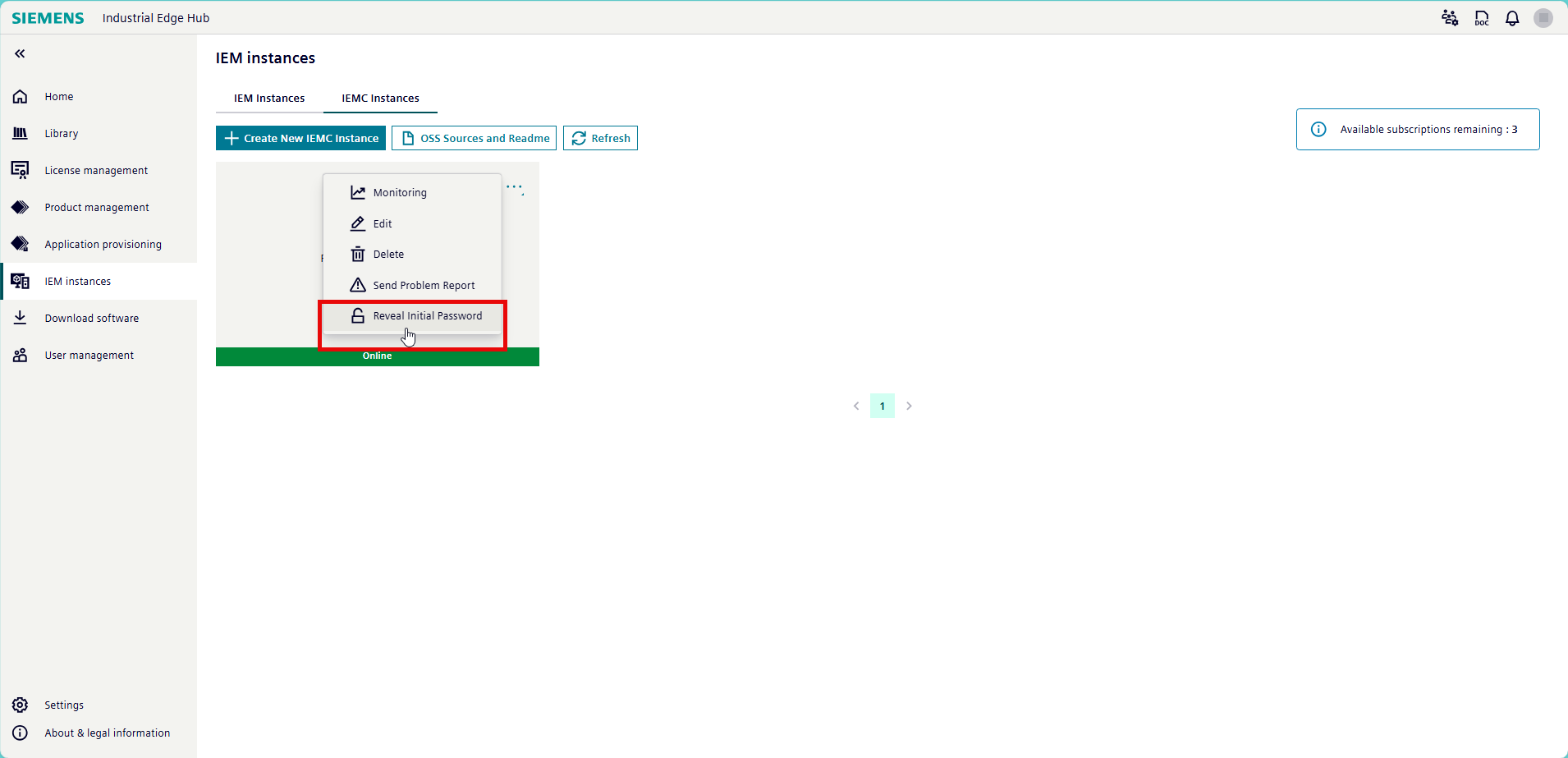
Click the "..." button for the IEM Cloud instance tile. A menu appears.
-
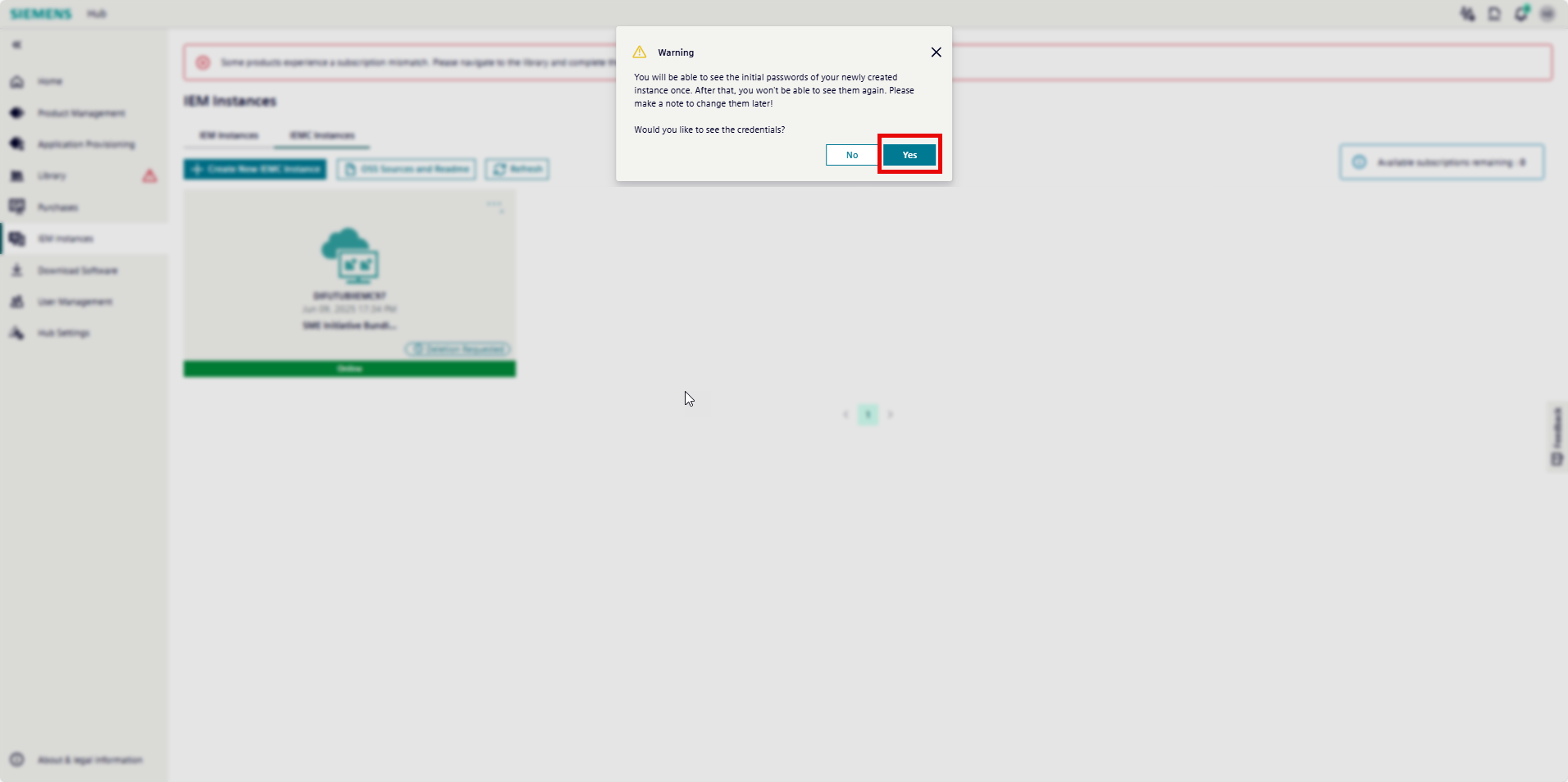
Click "Reveal initial password". A warning appears. You will only be able to view the username and password once.
-
Click "Yes".
- Note down the passwords or store them in your password manager.
- Open Industrial Edge Management by selecting the tile.
-
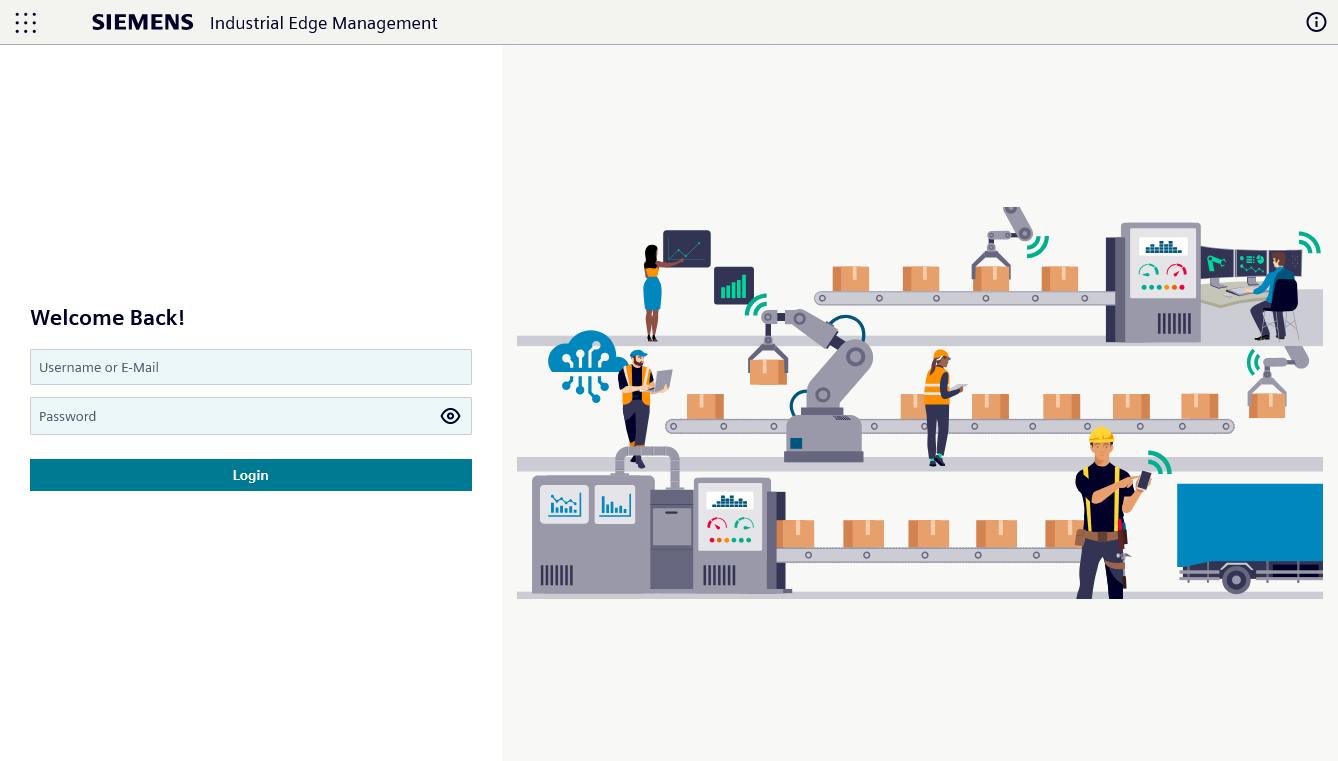
Log in with the initial username and password noted in step 7. Click "Login".
-
Update the password.
- Repeat steps 9–10 for the second user.
Validating the outcome for IEM Cloud
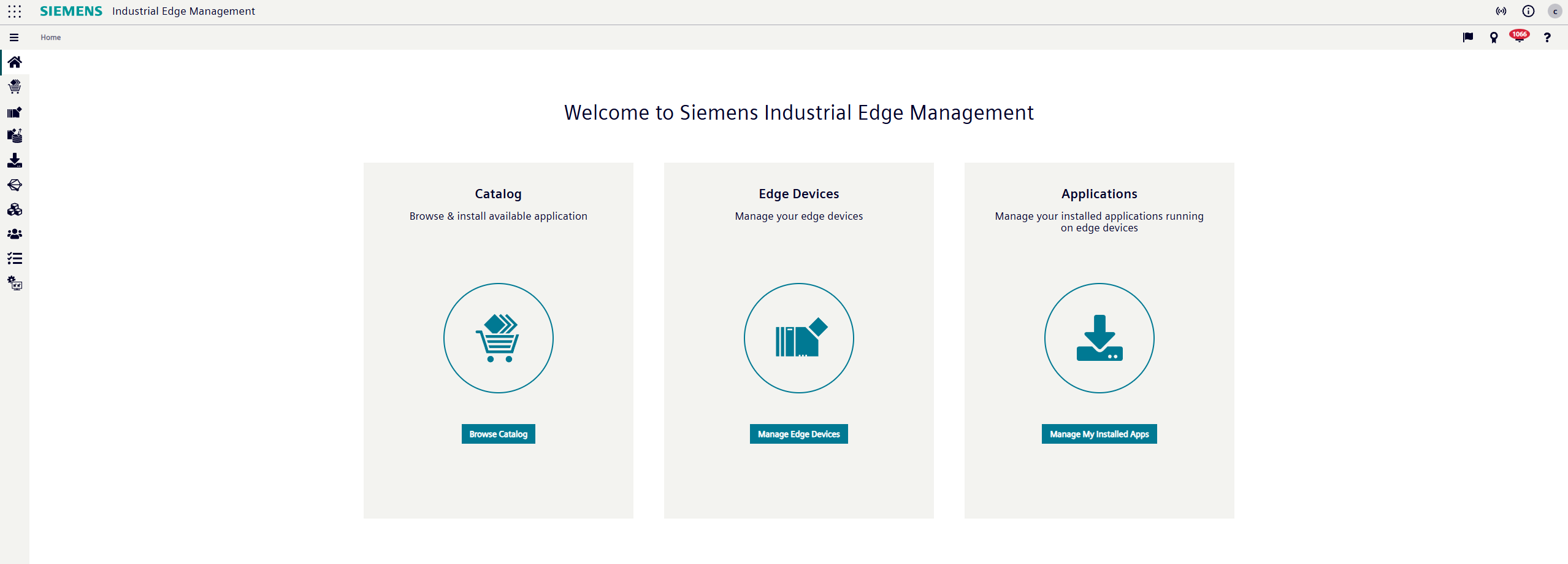
When everything is completed successfully, you should see the IEM Cloud launchpad after logging in. IEM Cloud is now fully set up.
Proceed to What's next?.
Setting up Industrial Edge Management Virtual
Industrial Edge Management Virtual (IEM Virtual) provides a streamlined installation experience for deploying Industrial Edge Management as a virtual machine on ESXi, Hyper-V and VMware Workstation hypervisors. It is ideal for customers seeking a to host the IEM in their own setup and infrastructure. IEM Virtual stores all data on-premises and offers robust service and maintenance features to support reliable business operations.
Prerequisites for IEM Virtual
- You have ordered Industrial Edge Hub Access
- You have received an email about the IE Hub Access.
- You have outbound internet access for the onboarding process and IEM to IEH communication. Refer to our IP protocols, ports services and domain names for more information.
-
You have a Hypervisor software (multiple on one device can cause issues): Hyper-V or VMWare
- Hyper-V
- You have a Tool to extract
.xz(Linuxxz/tar, or Windows tools such as 7‑Zip) - You have Administrative rights on the Hyper‑V host
Notice
Follow official Microsoft instructions: Enable Hyper-V on Windows
Optional quick PowerShell (run elevated) example for Windows Server / Pro editions:
Enable-WindowsOptionalFeature -Online -FeatureName Microsoft-Hyper-V -All -NoRestartReboot the host if Hyper‑V was newly enabled. * VMware Workstation Player or VMware Workstation Pro.
- You have a Tool to extract
- Hyper-V
-
An existing network setup
-
IP plan ready (static or static through DHCP)
NOTICE
For productive use, use a fully qualified domain name (FQDN) that is resolvable by a DNS server. A static IP address should only be used for testing or development.
NOTICE
Ensure the IP address doesn't change over the lifetime of the IEM. If the IP address changes, the IEM may stop functioning. If you use DHCP, configure an IP reservation or a static lease so the assigned IP does not change.
-
External virtual switch configured (recommended). Internal switch only for advanced routing/NAT setups.
Creating a NAT Switch on Hyper‑V Manager
For official guidance, consult the Microsoft Hyper‑V documentation on virtual switches and NAT configuration.
-
-
Minimum free disk space: size of extracted
.vhdxplus growth buffer - Hardware requirements for IEM Virtual allocation
- RAM (Memory) - 16 GB
- Hard Disk Size - 300 GB (Attach as existing disk)
- Number of CPUs - 4
- IEM Virtual must have exactly 1 network interface
Creating the virtual machine
This section illustrates creating a virtual machine using the VMware Workstation or Hyper-V hypervisor. Contact Siemens Support for additional help creating a virtual machine for the ESXi hypervisor.
Conditional steps
Downloading and creating the virtual Machine
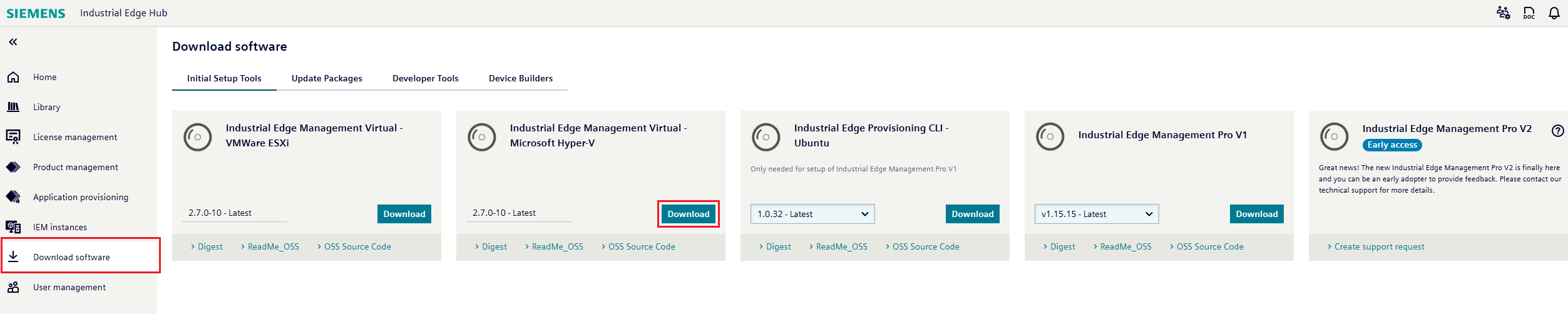
- Open Industrial Edge Hub.
- Click "Download software" from the left navigation pane. The "Download software" page opens.
-
Click "Download" on the tile named "Industrial Edge Management Virtual - Microsoft Hyper-V". Save the file locally. The .vhdx file downloads.
-
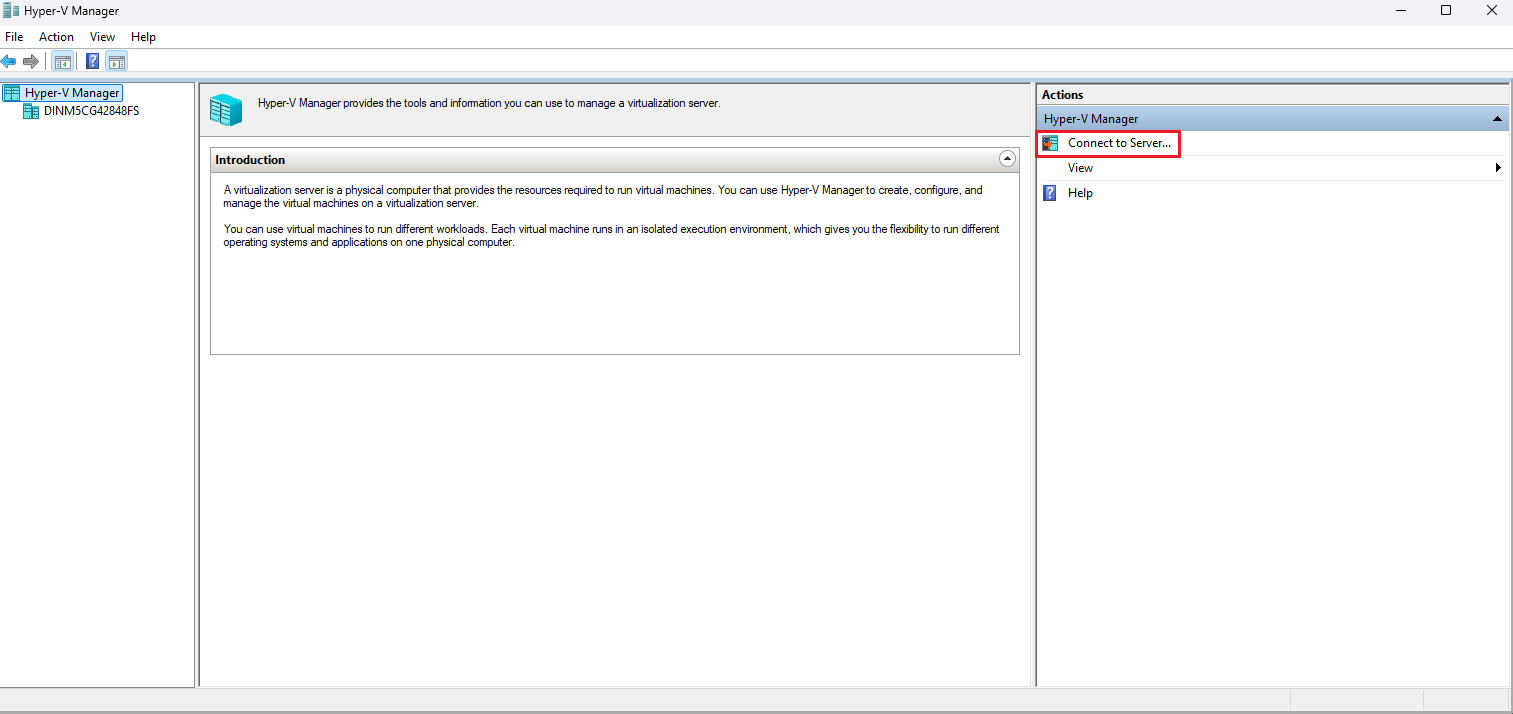
Open Hyper‑V Manager.
-
In the right-hand "Actions" pane, click "Connect to Server...".
-
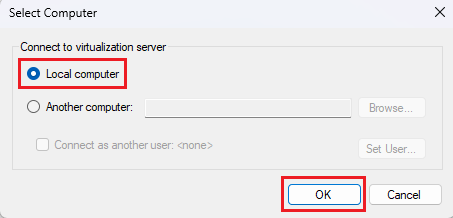
Select "Local computer" and click "OK".
-
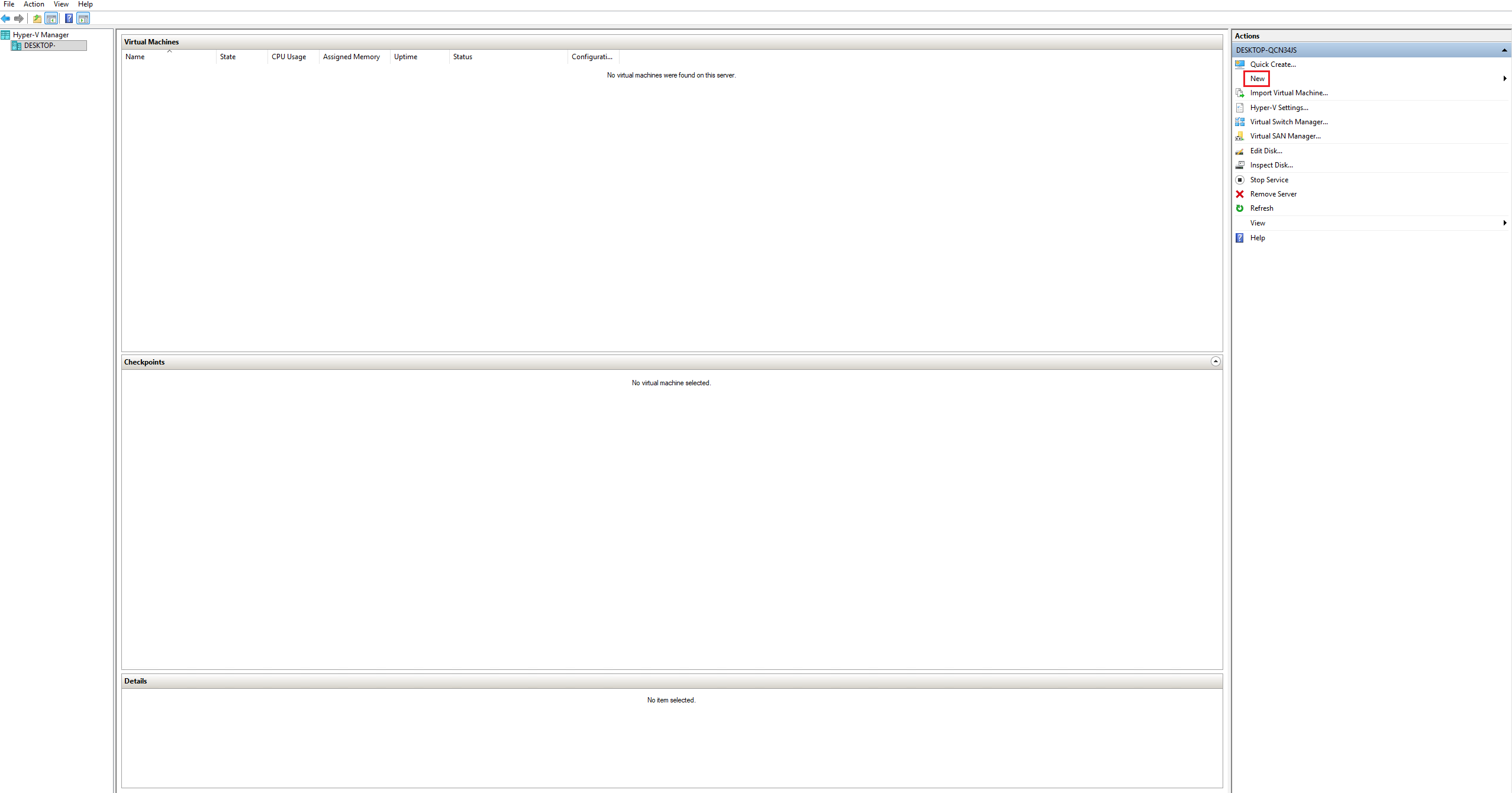
In the right "Actions" pane, click "New" to open the "New Virtual Machine Wizard".
-
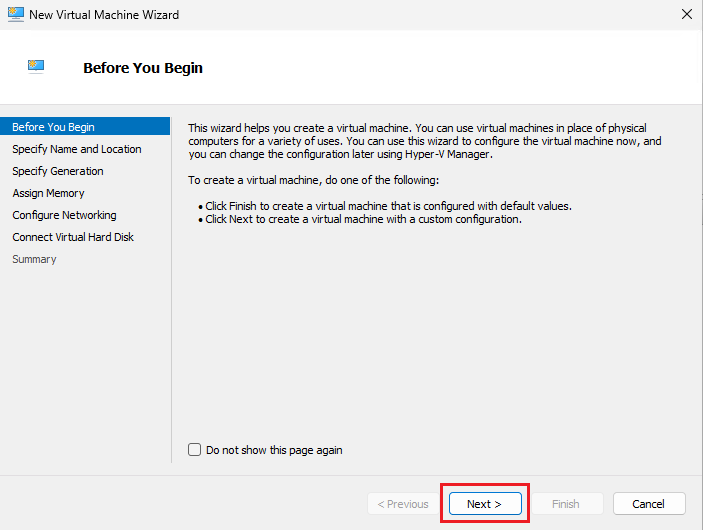
In the "New Virtual Machine Wizard", click "Next".
-
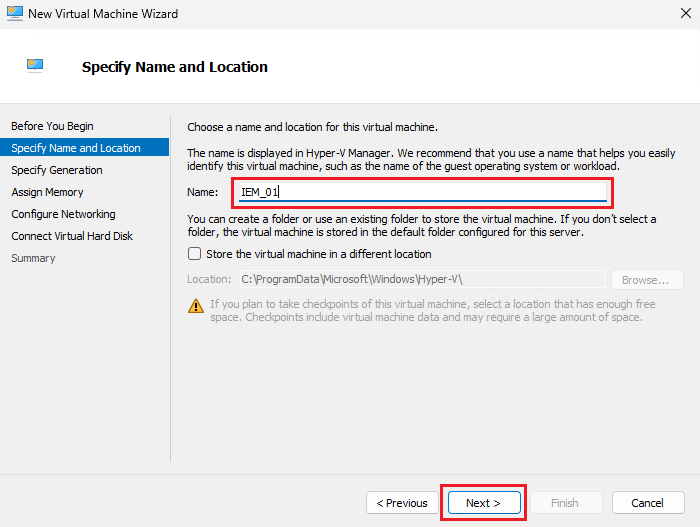
Enter a name for the virtual machine. Change the default store path if needed. Click "Next".
-
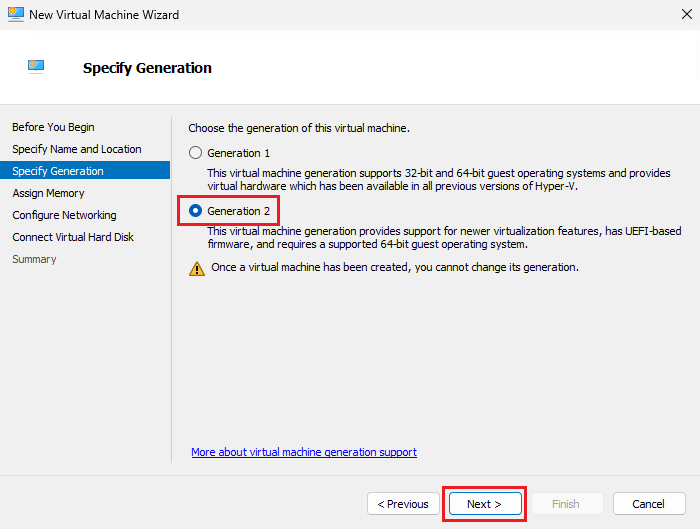
Choose "Generation 2" and click "Next".
-
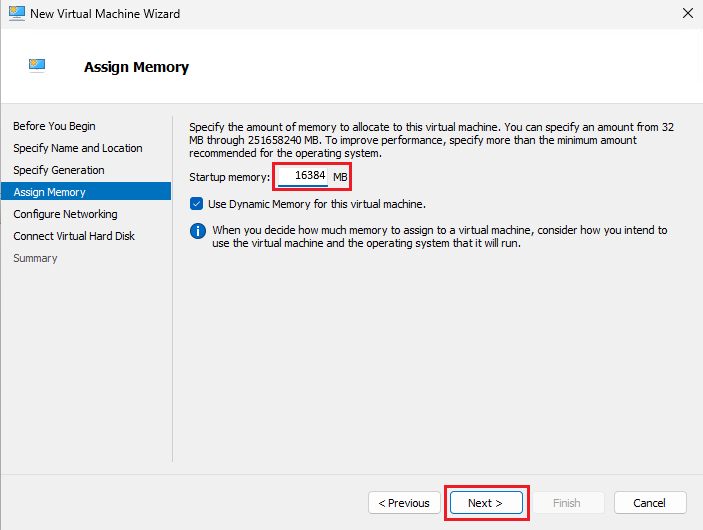
Enter the amount of memory to allocate. The memory allocated must be above 16 GB, the minimum memory requirement for IEM Virtual. Click "Next".
-
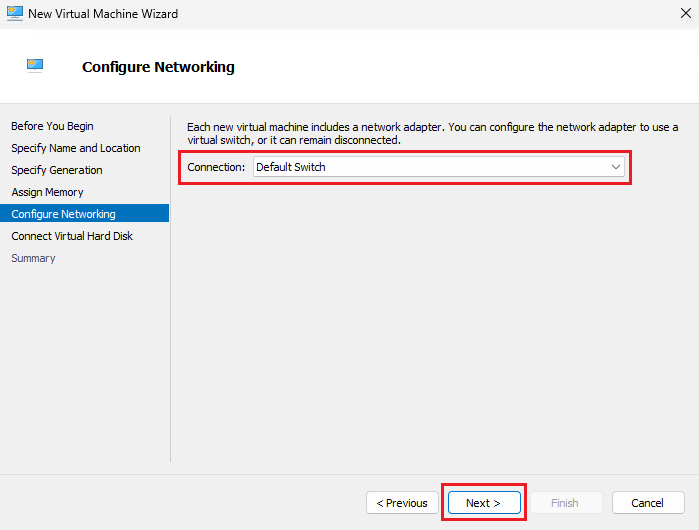
Choose a virtual switch according to your network setup (this guide uses the "Default Switch"). Click "Next".
-
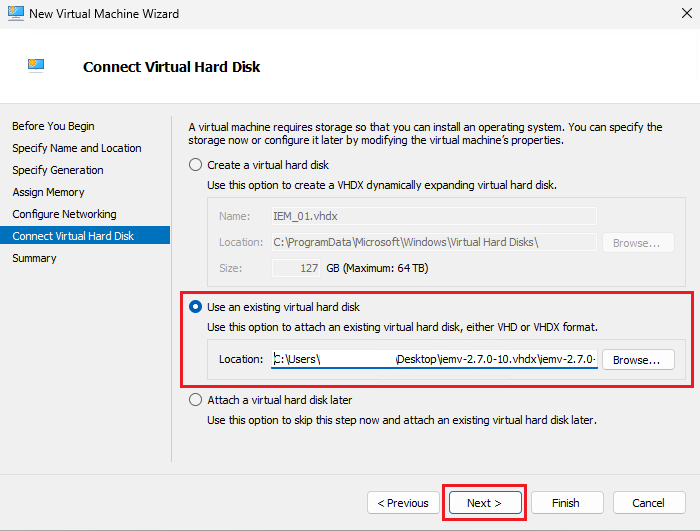
Select "Use an existing virtual hard disk", browse to the downloaded IEM .vhdx file, select it, and click "Next".
-
Review the configuration and click "Finish". The virtual machine is created and appears under "Virtual Machines".
Configuring the VM settings
-
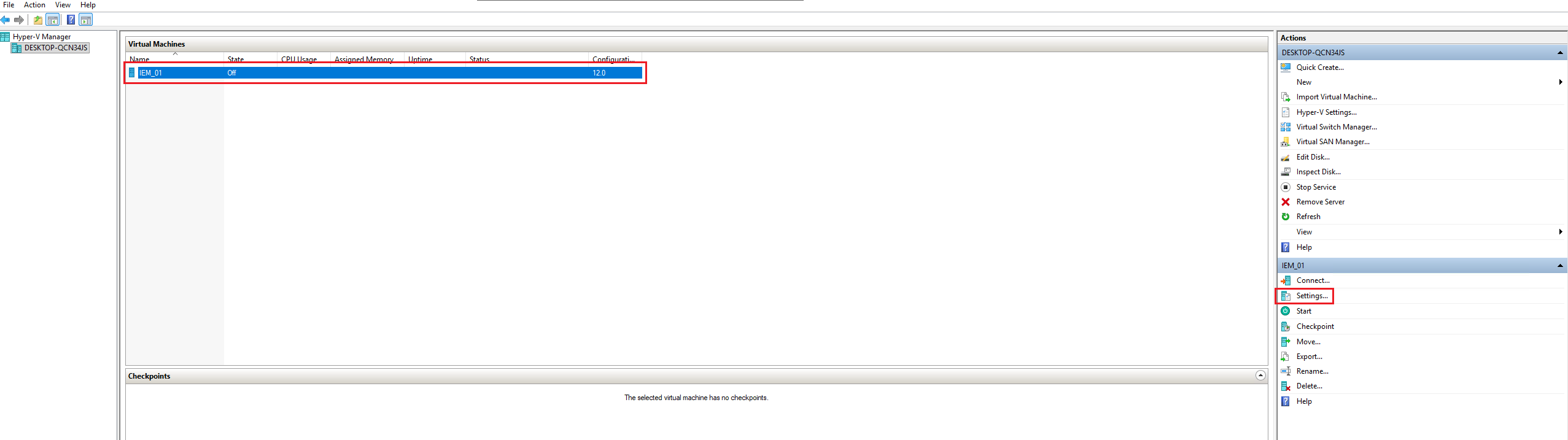
Select the previously created virtual machine and click the "Settings" button in the bottom-right pane.
-
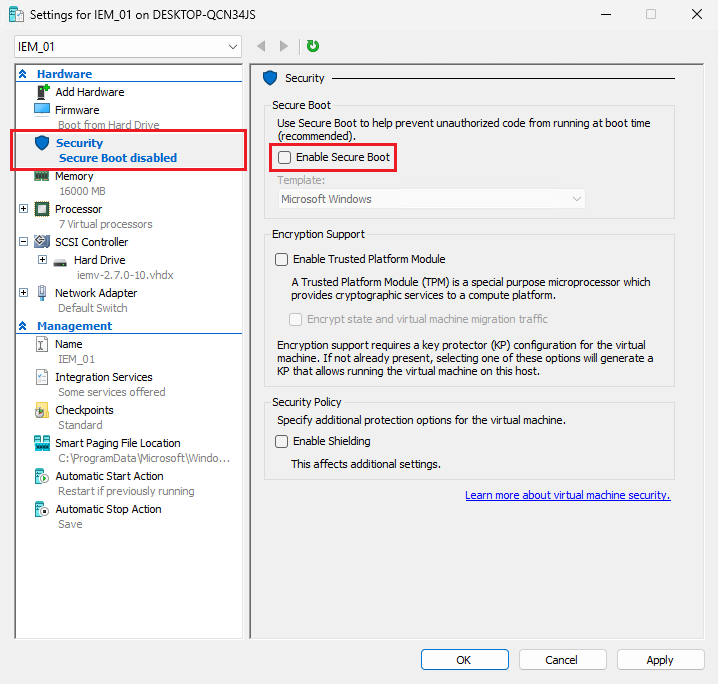
In the left pane select "Security" and uncheck "Enable Secure Boot".
-
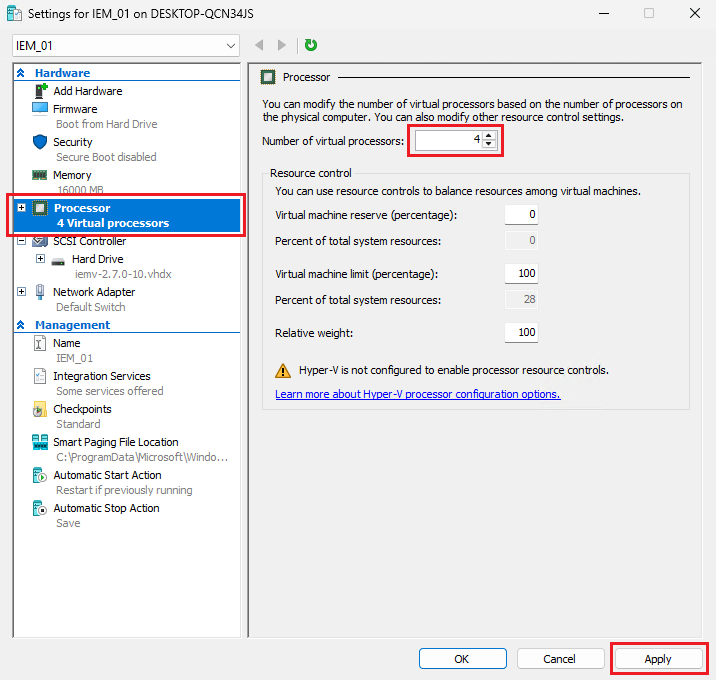
In the left pane select "Processor", set the number of processors (see prerequisites for minimum requirements), and click "Apply".
-
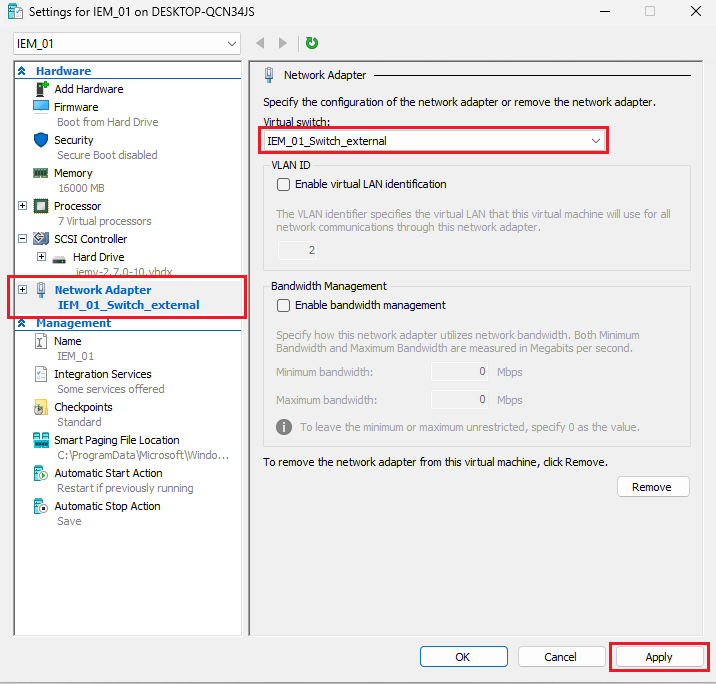
(Optional) In the left pane select "Network Adapter", choose a suitable network adapter, click "Apply", then click "OK".
Booting the virtual machine and accessing the UI
-
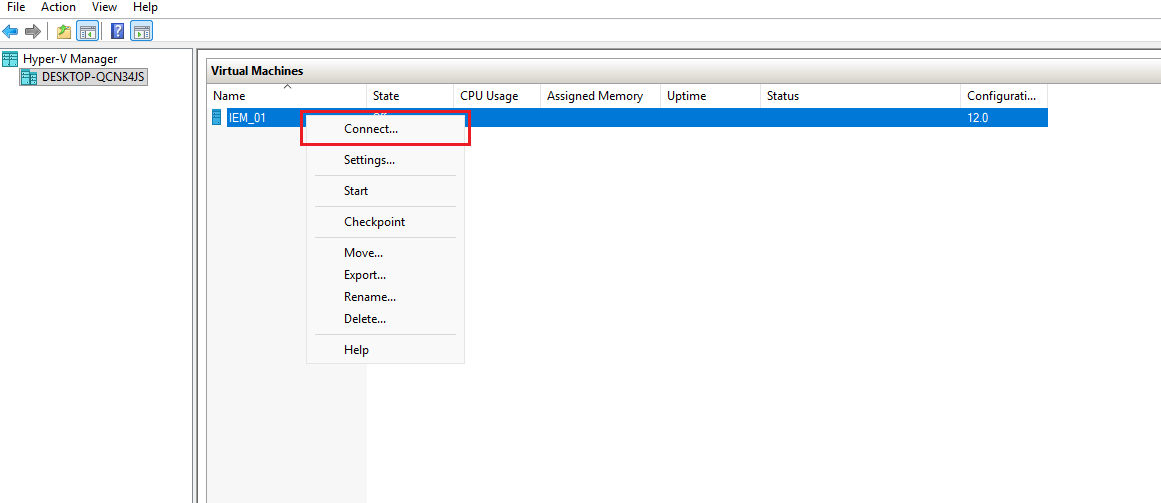
Right-click the virtual machine, select "Connect", then click "Start".
-
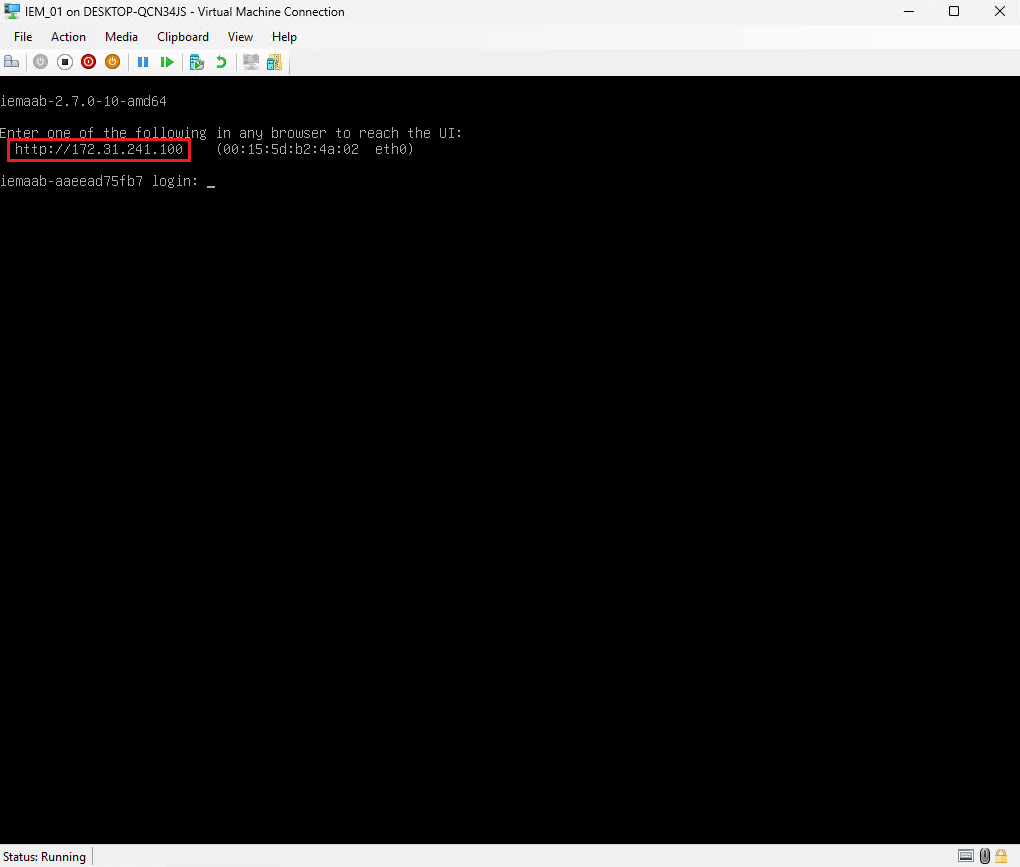
The virtual machine's console display appears. Note the shown IP address and use it in a browser to continue with the setup.
Static IP Configuration
If there is no DHCP server available in your environment, configure a static IP address from the console so you can access the First Boot Wizard for further configurations. Proceed with Initial Network Configuration to set up a static IP address.
NOTICE
Do not reduce CPU/RAM during onboarding period.
Troubleshooting
| Symptom | Possible Cause | Action |
|---|---|---|
| Secure Boot violation message | Secure Boot still enabled | Disable in VM Settings > Security and retry boot |
| No network / APIPA address | Wrong switch type or DHCP unavailable | Switch to External; configure static IP |
| Slow onboarding | Insufficient resources / Dynamic Memory enabled | Ensure 4 vCPU, 16 GB RAM, Dynamic Memory disabled |
| VHDX not listed | File still compressed or permissions | Ensure extraction completed; check NTFS permissions |
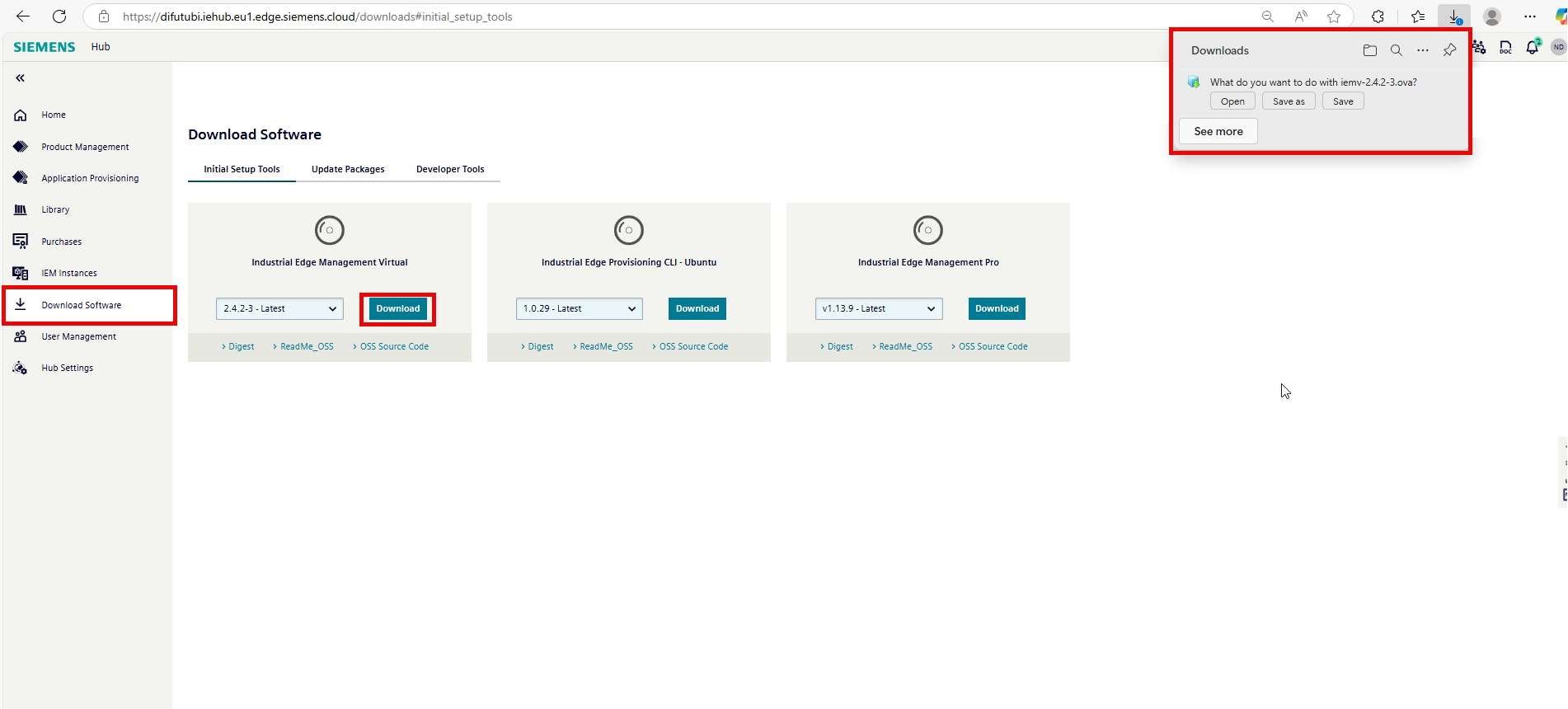
- Open Industrial Edge Hub.
-
Click "Download software" from the left navigation pane. The "Download software" page opens.
-
Click "Download" on the tile named "Industrial Edge Management Virtual - VMWare ESXi". Save the file locally. The .ova file downloads.
-
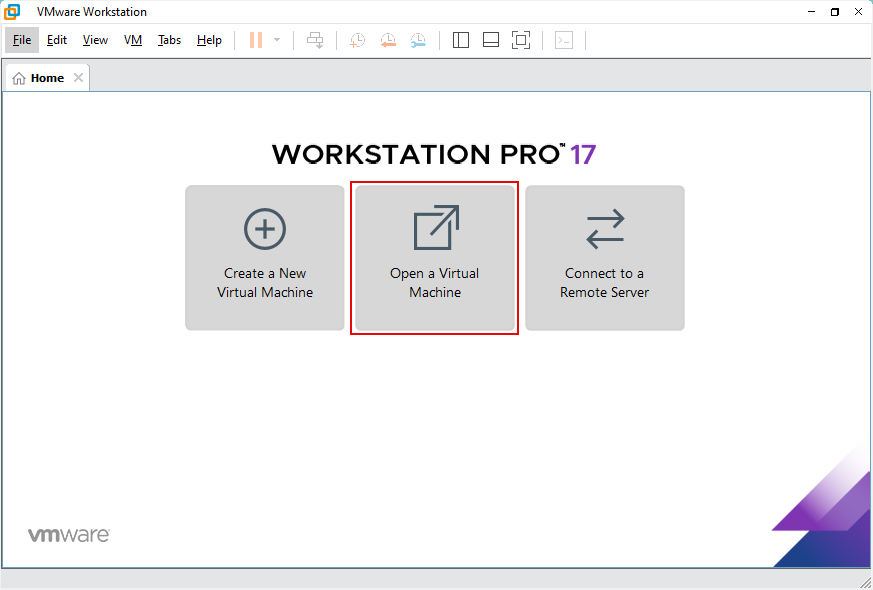
Open VMware Workstation Pro.
-
Click "Open a Virtual Machine".
-
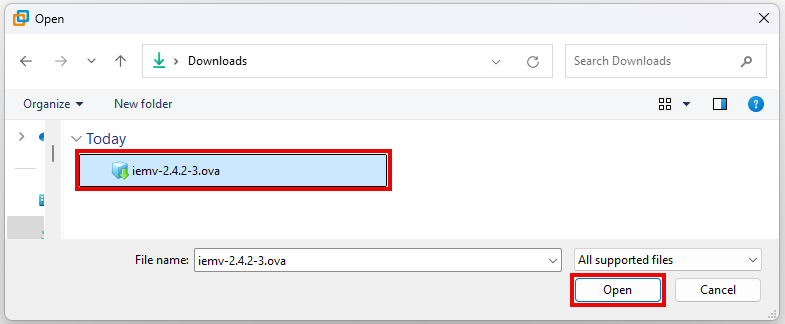
Select the .ova file downloaded from IE Hub.
-
Name the virtual machine and select a storage path.
-
Click "Import". VMware Workstation creates a virtual machine.
NOTICE
Do not reduce CPU/RAM during onboarding period.
Configuring the virtual machine network adapter for IEM Virtual
The following steps show how to configure the IEM Virtual network adapter in VMware.
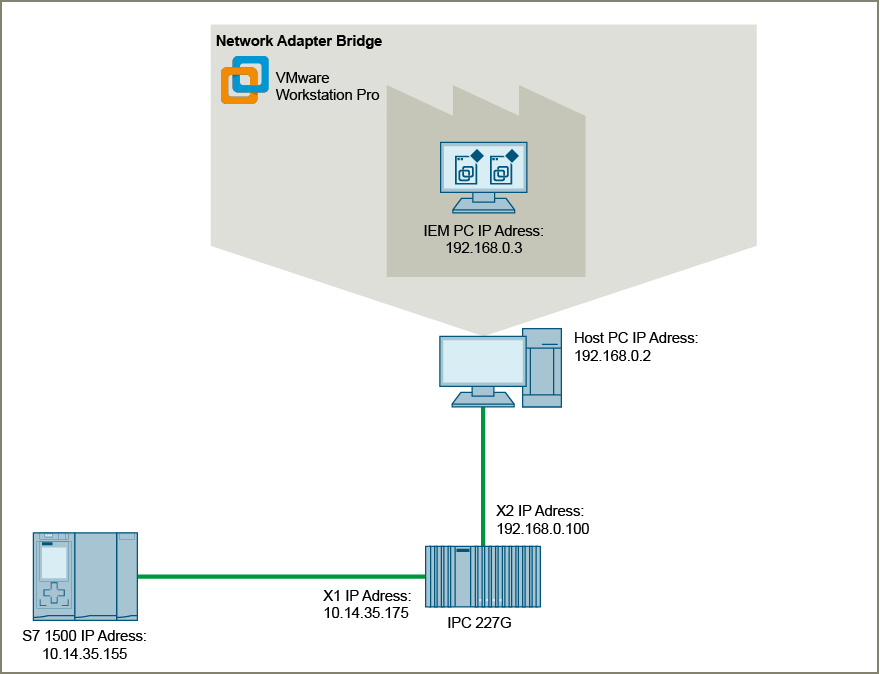
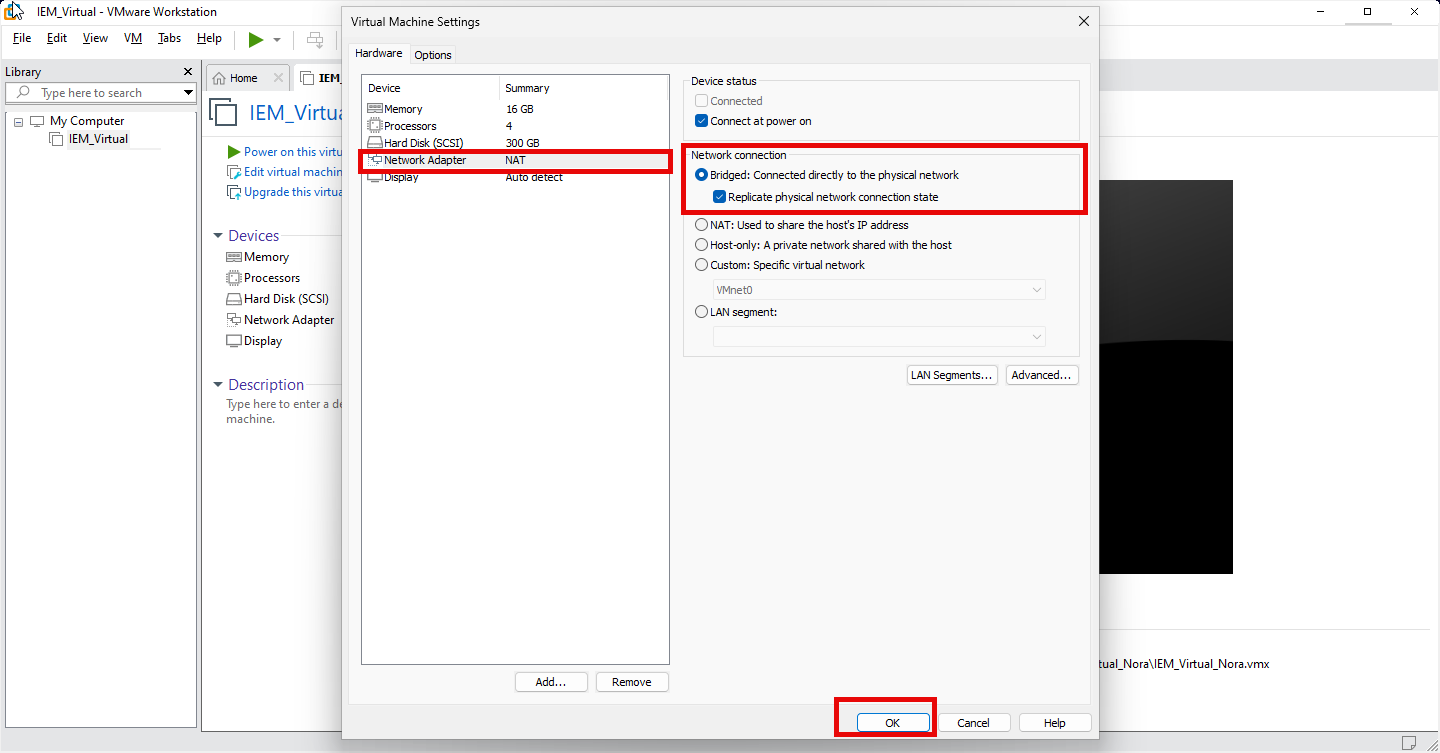
VMware uses a Network Address Translation (NAT) adapter by default, which prevents external devices from communicating with IEM Virtual. Change the adapter type to "Bridged" to allow IEM Virtual to communicate with other devices on the same network. Below you can find an image illustrating this setup.
Both IEM Virtual and the IE Device must be on the same network adapter to communicate effectively. Setting the IEM Virtual network adapter to "Bridged" mode ensures this connectivity. Using any other network adapter type prevents communication between the IE Device and IEM Virtual. The figure below illustrates the test configuration with IEM Virtual as the management system.
To configure the virtual machine network adaptor:
- Open the hypervisor for the virtual machine.
- Select the virtual machine for IEM Virtual.
-
Click "Edit virtual machine settings". The "Virtual machine settings" window opens.
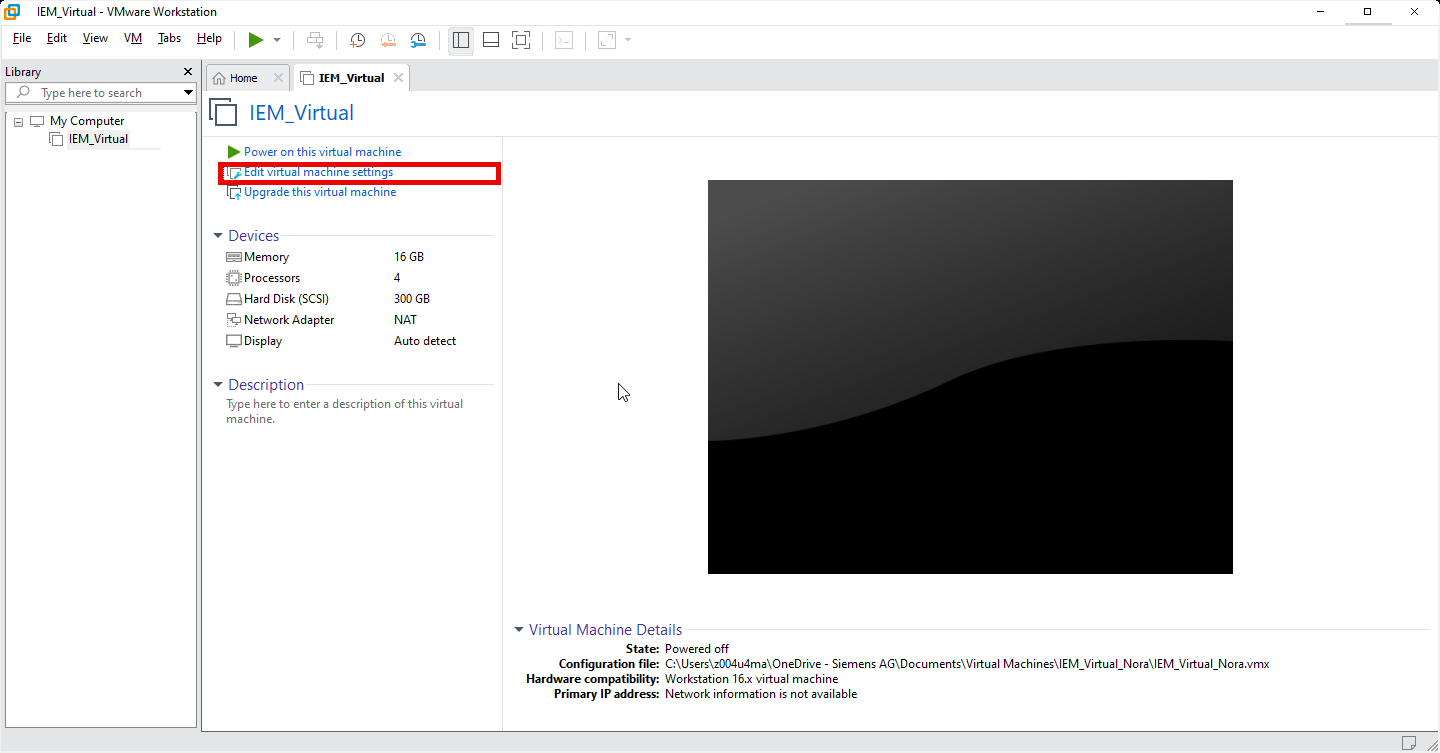
-
Click "Network Adapter" in the left panel. The right panel displays information about the network adaptor.
-
Set the "Network Connection" to "Bridged". Click the checkbox for "Replicate physical network connection state".
-
Click "OK".
-
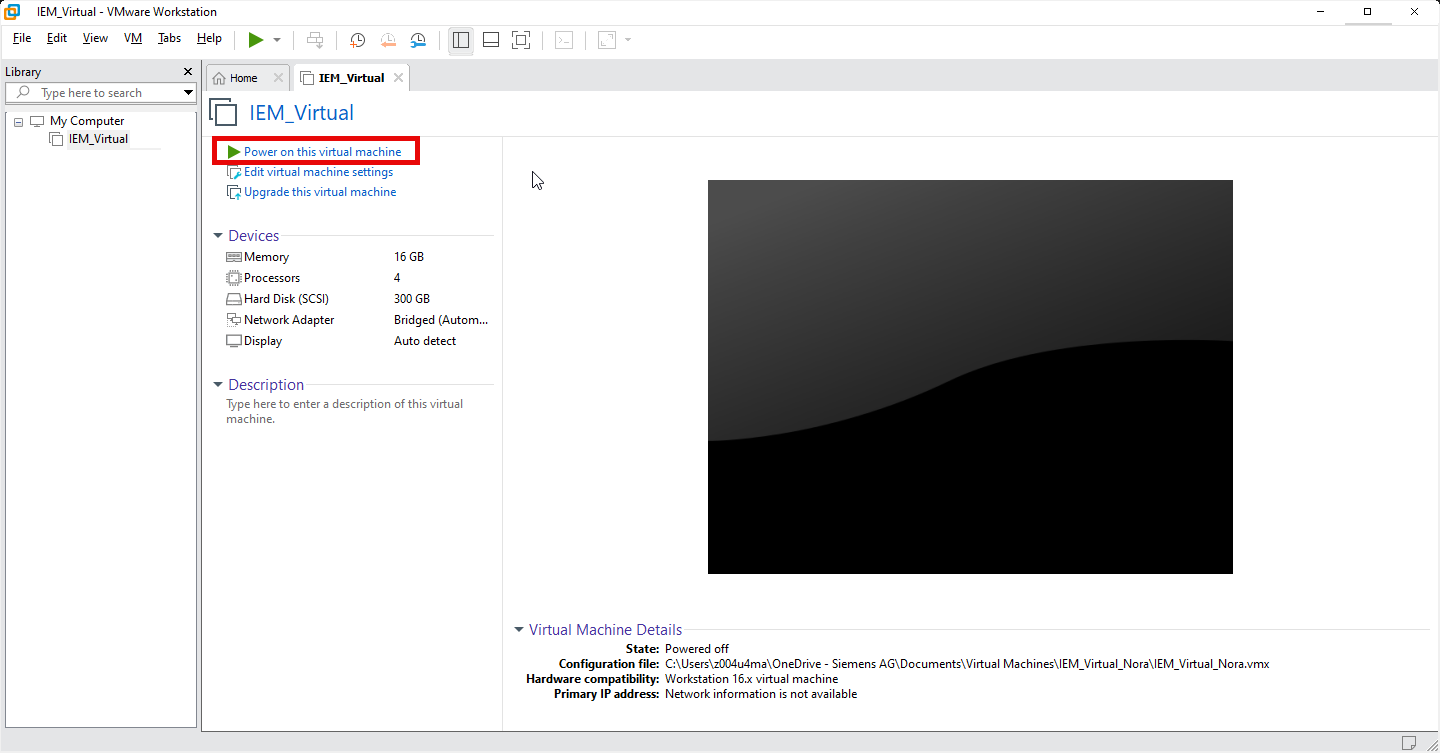
To turn on your virtual machine, click "Power on this virtual machine". The virtual machine powers on.
Obtaining a DHCP IP address
NOTICE
For productive use, use a fully qualified domain name (FQDN) that is resolvable by a DNS server. A static IP address should only be used for testing or development.
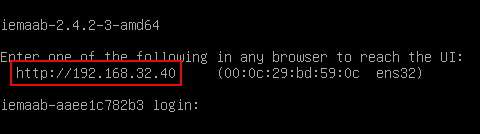
While booting up, the virtual machine obtains an IP address from the Dynamic Host Configuration Protocol (DHCP) server. The virtual machine displays this IP address on the console. This IP address is necessary for connecting IEM Virtual to the IE Device.

Note down the IP address of the virtual machine. Proceed to Creating and downloading the deployment file.
If the network does not have a DHCP server, the virtual machine displays the error message "No configured network found. Check cable or DHCP server?". The virtual machine cannot access IEM Virtual without an IP address. If there is no DHCP server available or a static IP address is required, specify the network configuration by defining a static IP address. You can then access IEM Virtual from a browser on the same network.

Defining a static IP address
The virtual machine requires an IP address to access IEM Virtual. If there is no DHCP server available or a static IP address is required, specify the network configuration by defining a static IP address.
- Boot up the virtual machine in the hypervisor.
-
Log in with the following credentials:
login:configpassword:config
-
To select the "Network Configuration", enter
1and pressEnter. -
Define the following network settings:
- The IP address to be assigned
- Subnet
- Gateway
- DNS
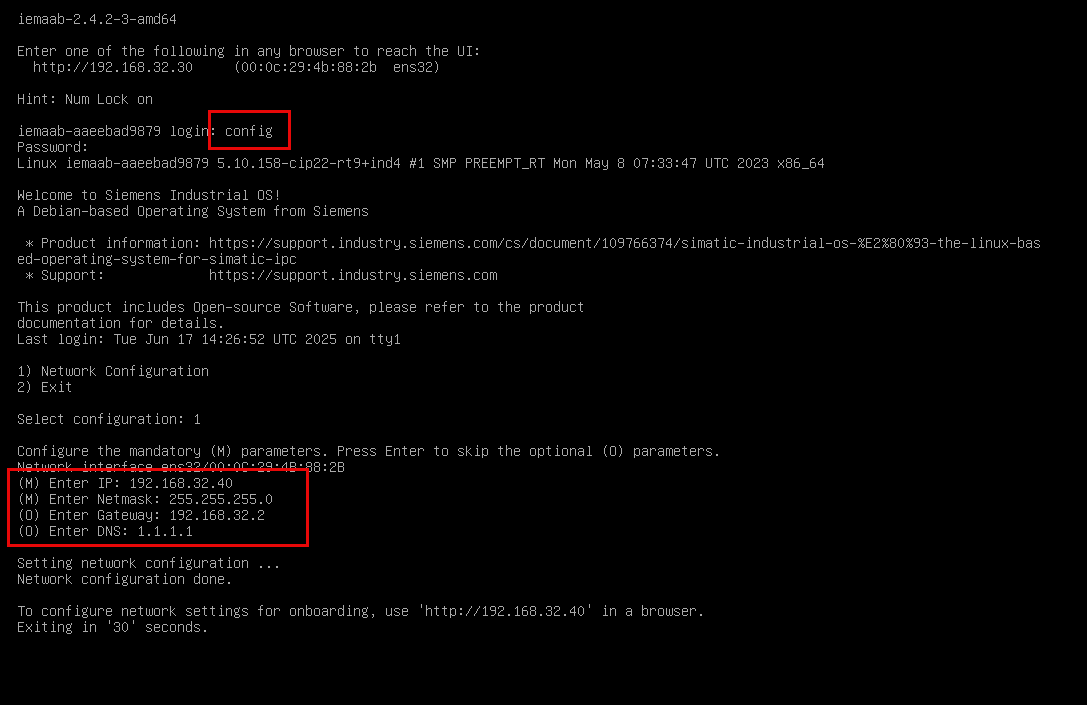
-
The hypervisor assigns the specified settings and IP address to IEM Virtual. The virtual machine now displays this IP address on the console while booting up. Use this IP address to reach the web server.
Proceed to Creating and downloading the deployment file.
Creating and downloading the deployment file
To establish a connection between your IE Hub and your IEM Virtual, a deployment file is needed. The deployment file contains the information (Ip Address, Hub Instance etc.) the IEM needs to establish a secure connection to the IE Hub. This connection is initiated by the IEM and is outbound from the secure network—avoiding any inbound access. Allowing the Hub to initiate inbound connections would increase the attack surface and create a security risk.
- Log in to IE Hub.
- Click "IEM instances" from the left navigation pane. The "IEM instances" page opens.
-
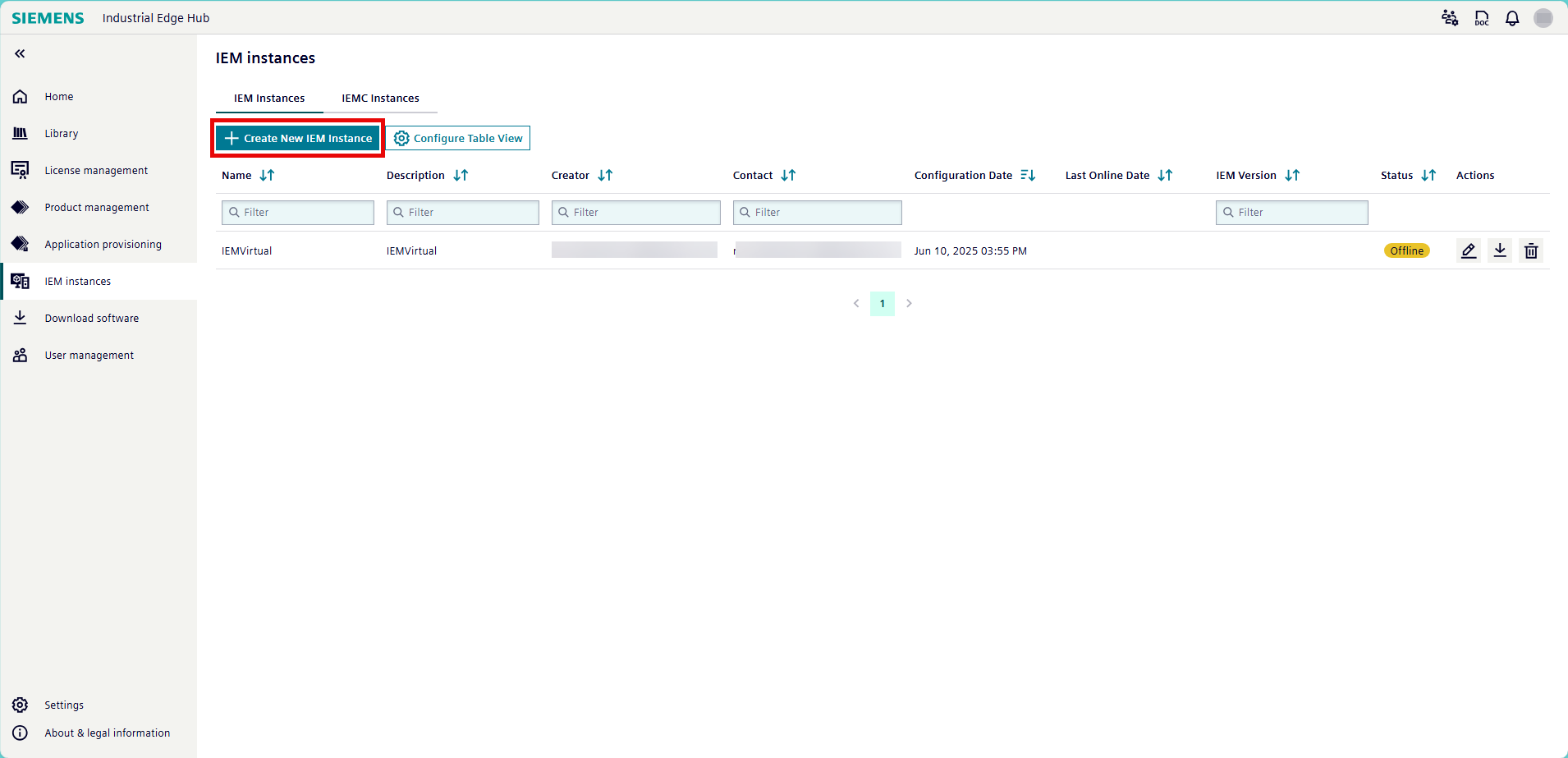
Click "Create New IEM Instance". The "Create IEM Instance" page opens.
-
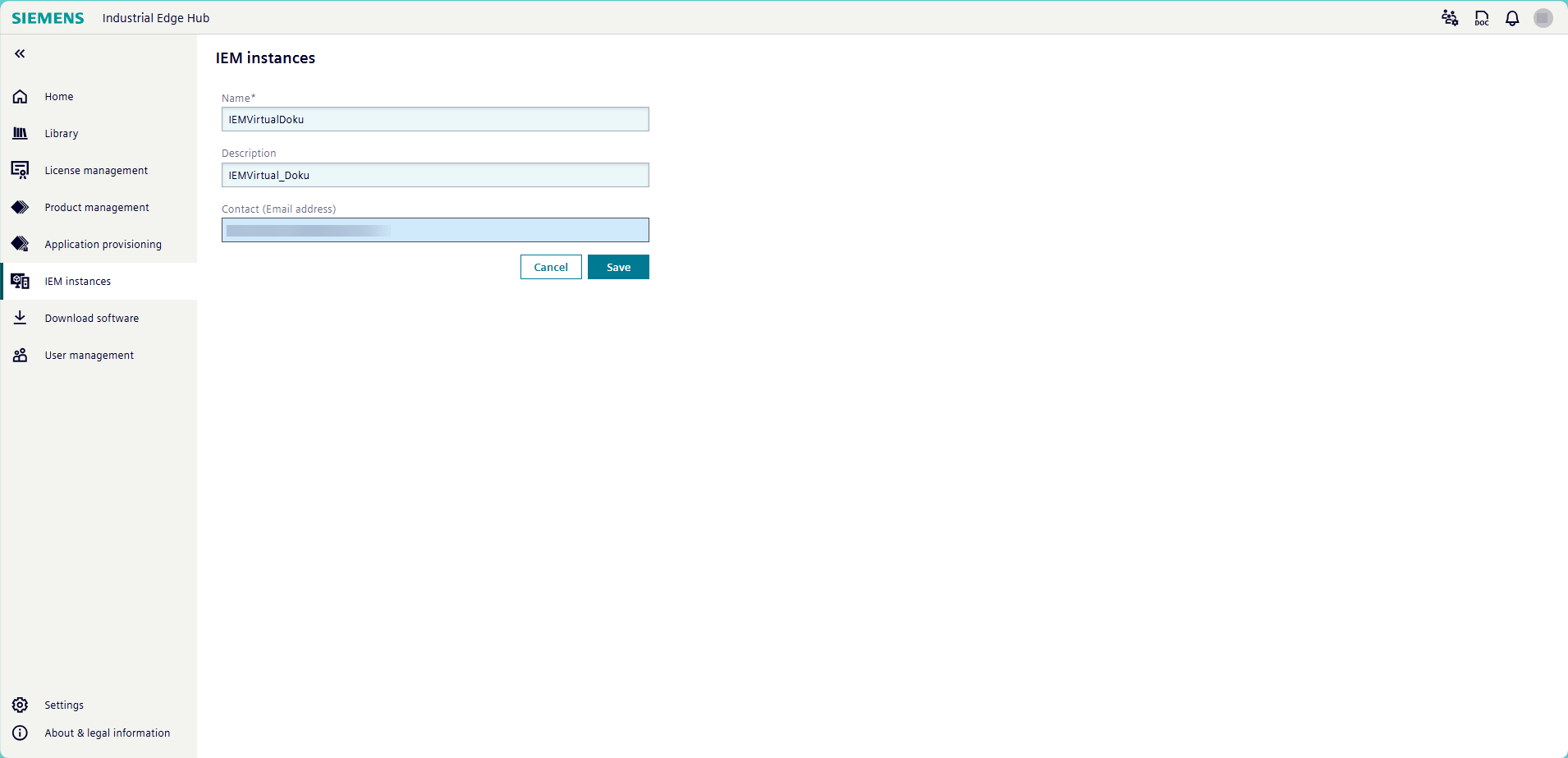
Give your IEM instance a name, a description, and an email address for the contact.
-
Click "Save". A status pop-up appears and displays the IEM instance creation process.
-
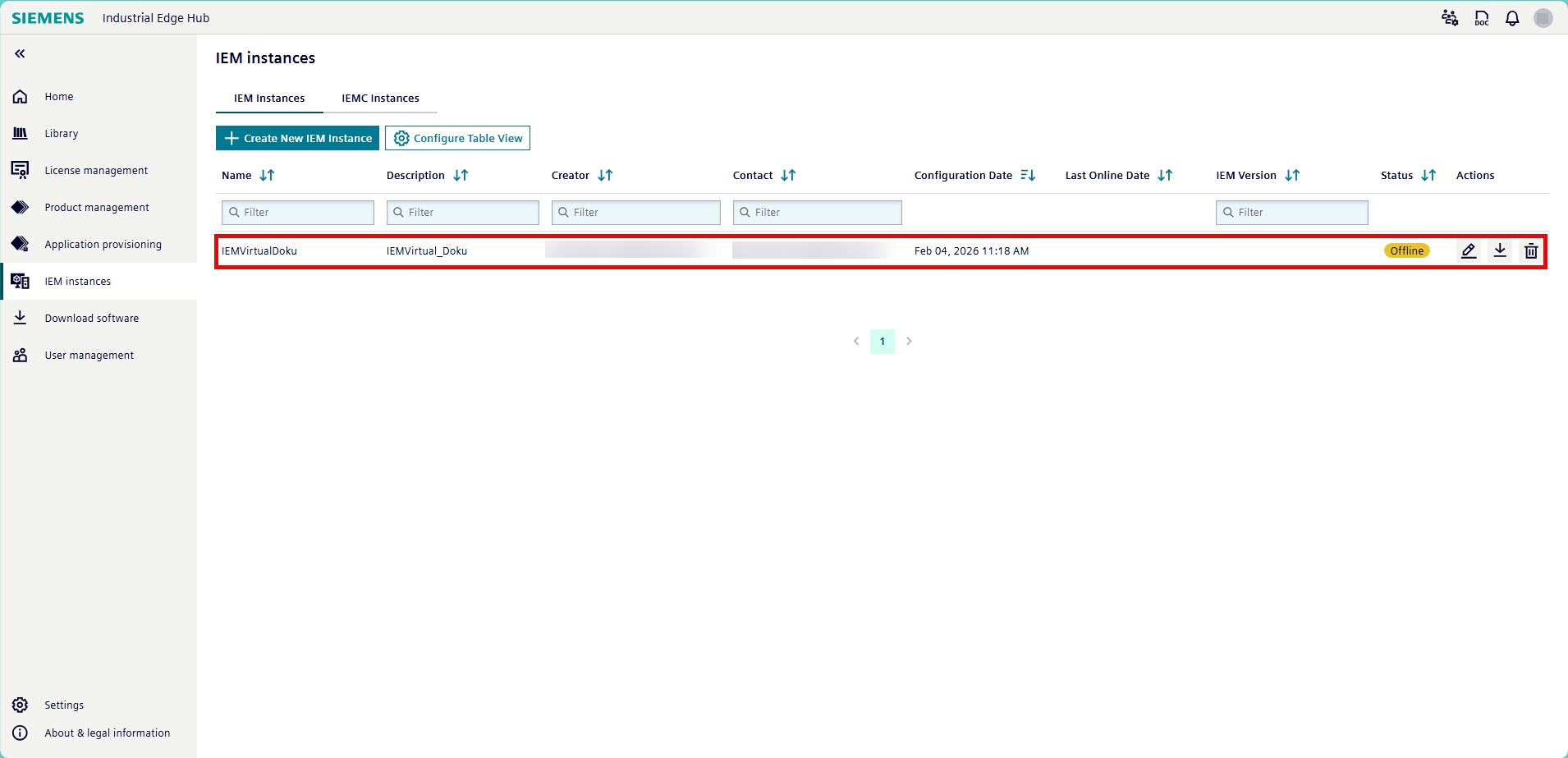
Navigate back to "IEM instances". IE Hub displays the new IEM instance when it is finished with the installation process.
-
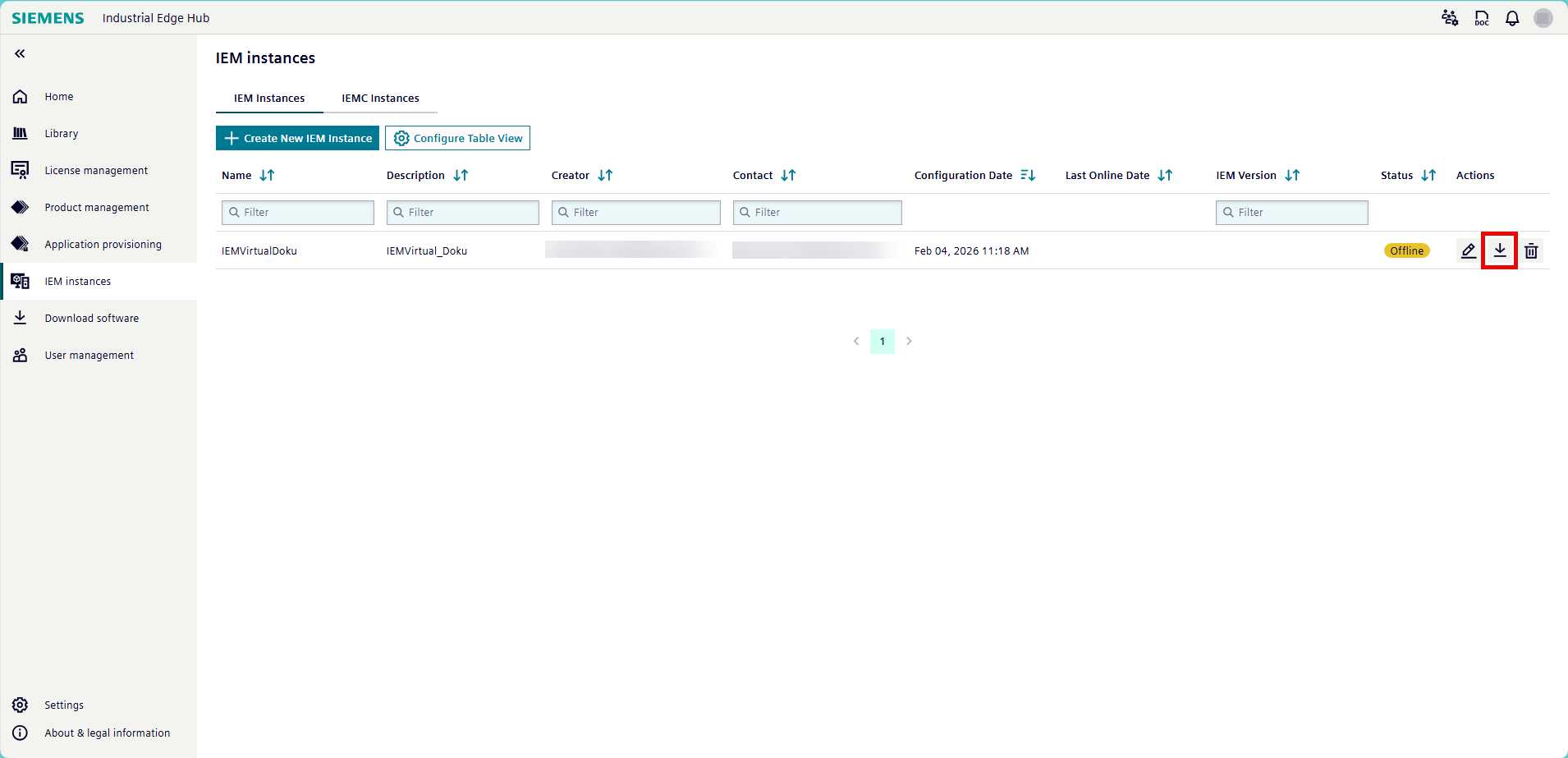
Click the "Download Configuration" icon in the "Actions" column for the IEM instance. The configuration file downloads according to your browser settings.
Valid for one hour
The configuration file is only valid for one hour. After one hour, the file expires and you must download a new configuration file.
Deploying IEM Virtual
After obtaining an IP address for IEM Virtual and downloading the configuration file for the IEM Virtual instance from IE Hub, deploy IEM Virtual.
- Open a web browser on the host PC or a client PC that is on the same network as IEM Virtual.
-
Enter the IP address of IEM Virtual with
http:/<IP address of IEM>. The browser displays THE "Your connection isn't private" warning page as no certificates have been configured yet.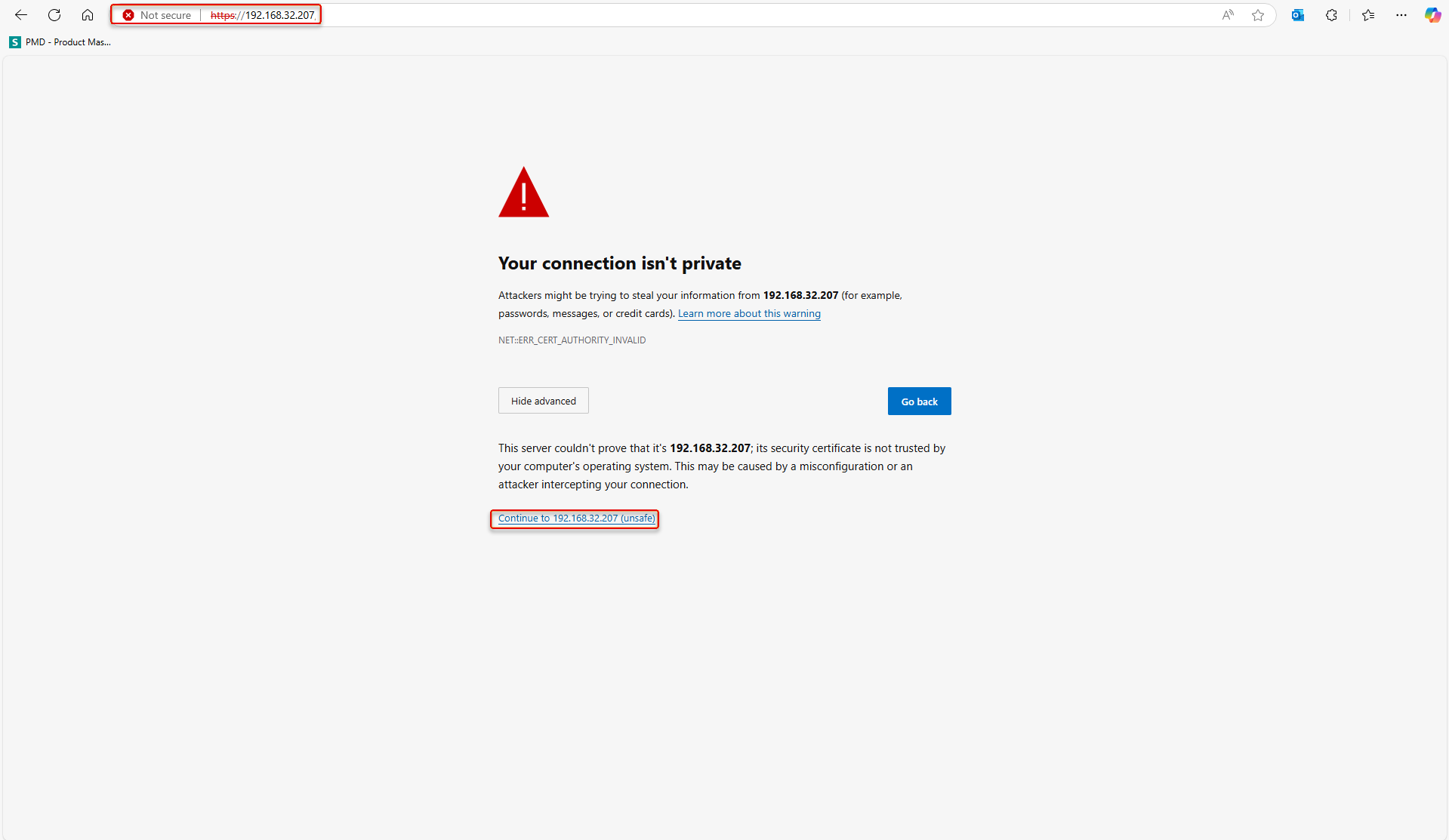
-
Click "Continue to XXX.XXX.XX.XXX (unsafe)". IEM Virtual automatically redirects to the Industrial Edge Virtual setup wizard.
-
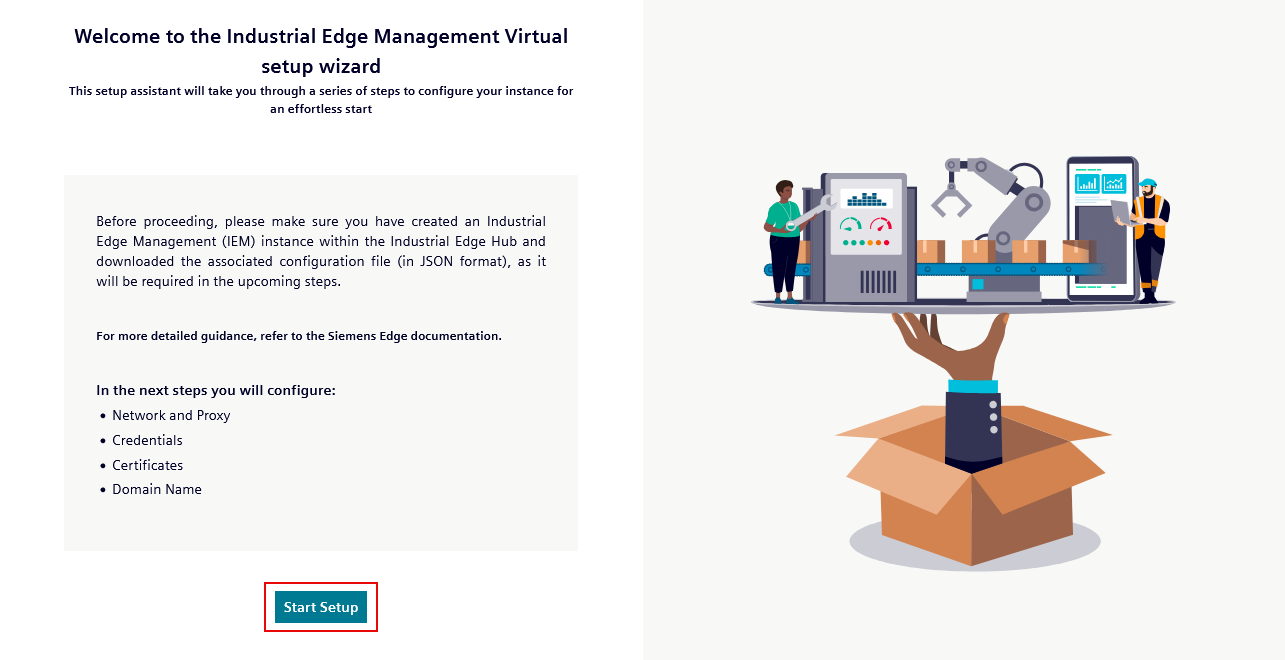
Click "Start Setup". The "Network & Proxy" page of the setup wizard opens.
-
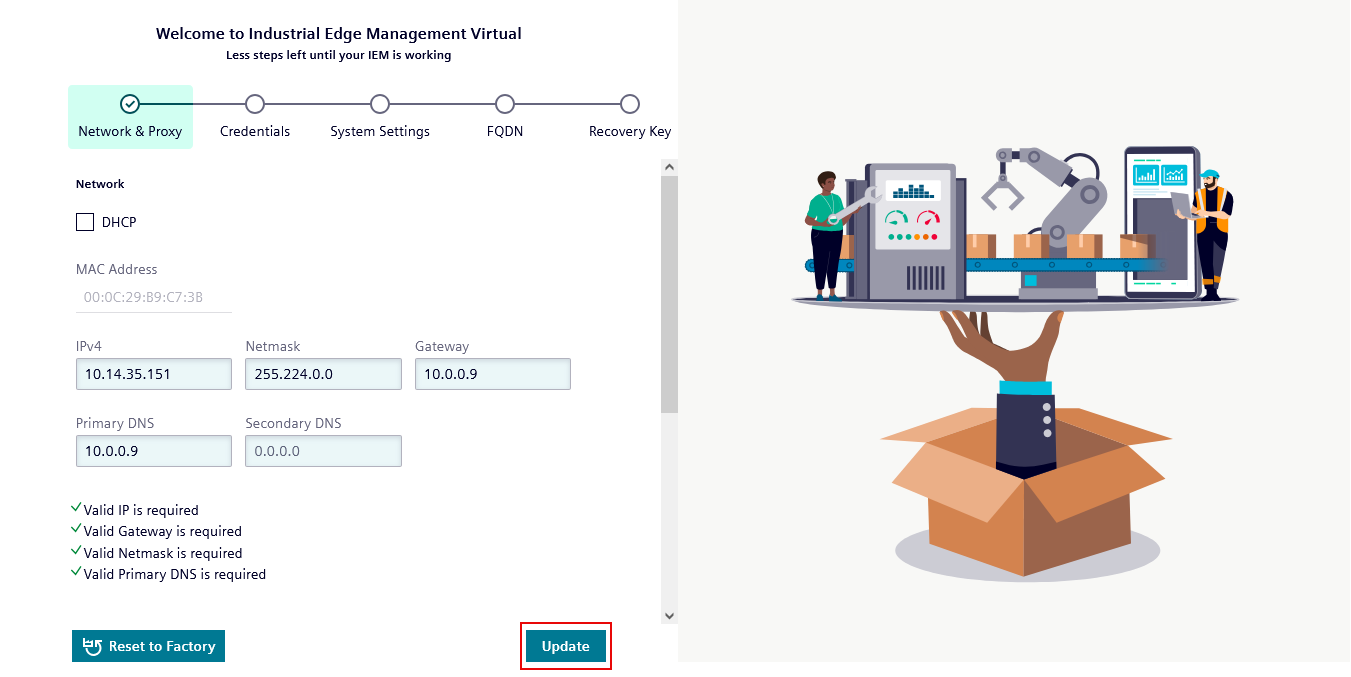
If you need to update the network configuration, adjust the settings and click "Update" to save the configuration. If not, click "Next".
NOTICE
The configuration file is only valid for one hour. After one hour, the file expires and you must download a new configuration file. Ensure "Gateway" and "DNS" are input correctly to allow IEM Virtual to access the Internet. IEM Virtual requires an Internet connection to connect to IE Hub for license matching.
NOTICE
Ensure the IP address remains constant for the lifetime of the IEM. If the IP address changes, the IEM may stop functioning. If you use DHCP, configure an IP reservation or a static lease so the assigned IP does not change.
-
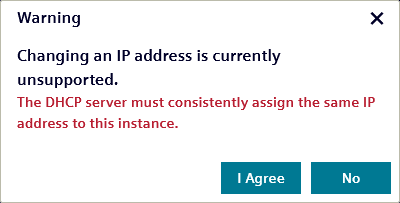
If you have selected DHCP, click "I agree" to confirm that the IP address will not change. The "Credentials" page of the setup wizard opens.
-
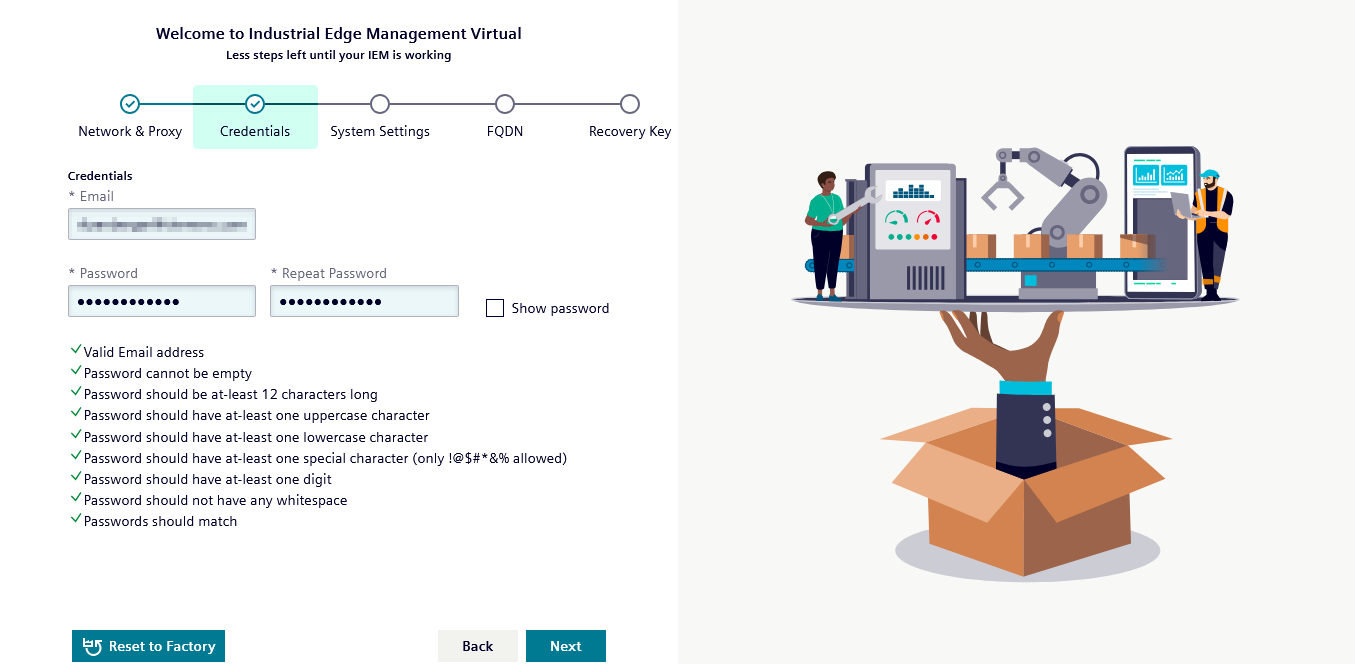
Define the credentials for logging in to the IEM. Ensure the password adheres to the listed requirements.
-
Note down the credentials or store them in your password manager.
-
Click "Next". The "System Settings" page of the setup wizard opens.
-
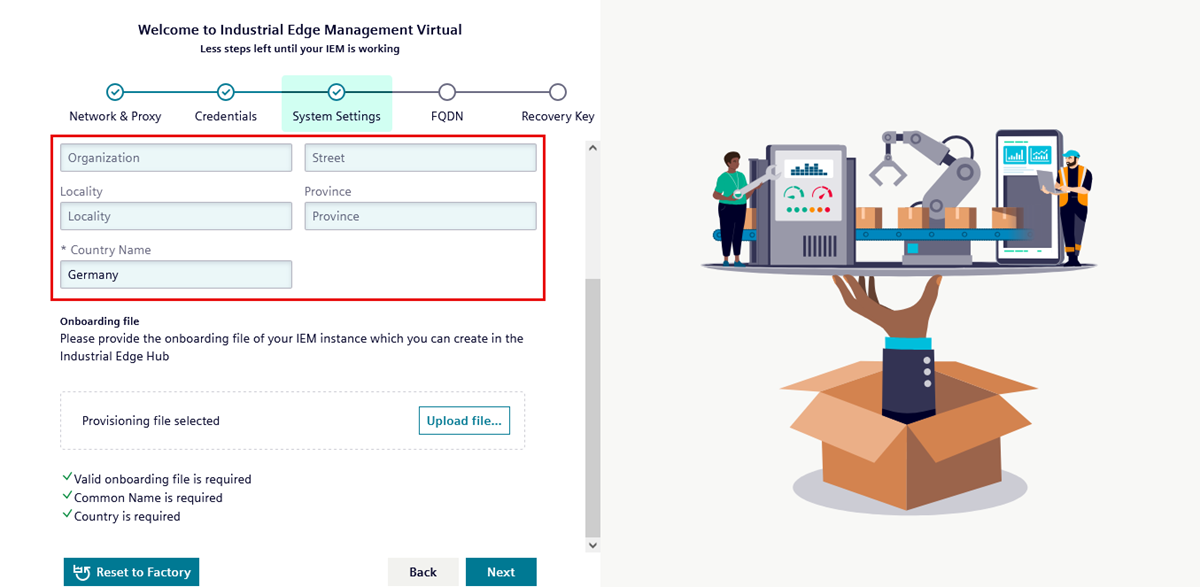
Select "self-signed certificate". Input information for "Organization", "Street", "Locality", "Province", and "Country Name". The setup wizard generates a self-signed certificate from this information.
Self-signed certificates
This tutorial shows the process for self-signed certificates. It is also possible to store your own certificate in IE Hub in advance. The certificate type cannot be changed afterwards.
-
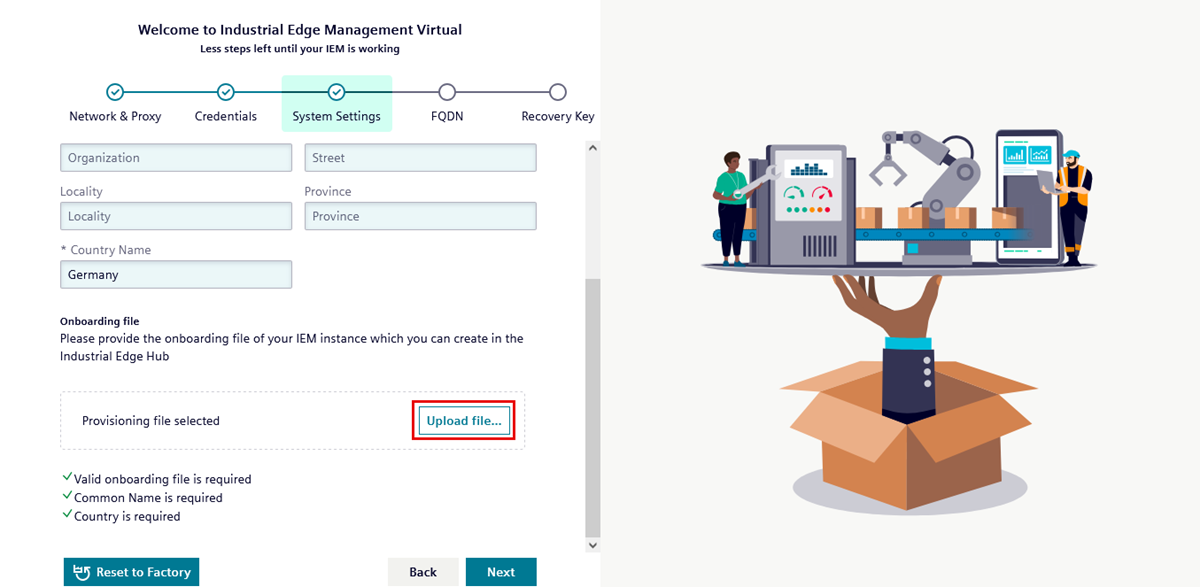
Under "Onboarding file", click "Upload file..." and select the generated configuration file.
-
Click "Next". The "FQDN" page of the setup wizard opens.
-
For a test setup, leave the "Fully Qualified Domain Name (FQDN)" field blank. For a productive setup, enter an appropriate fully qualified domain name.
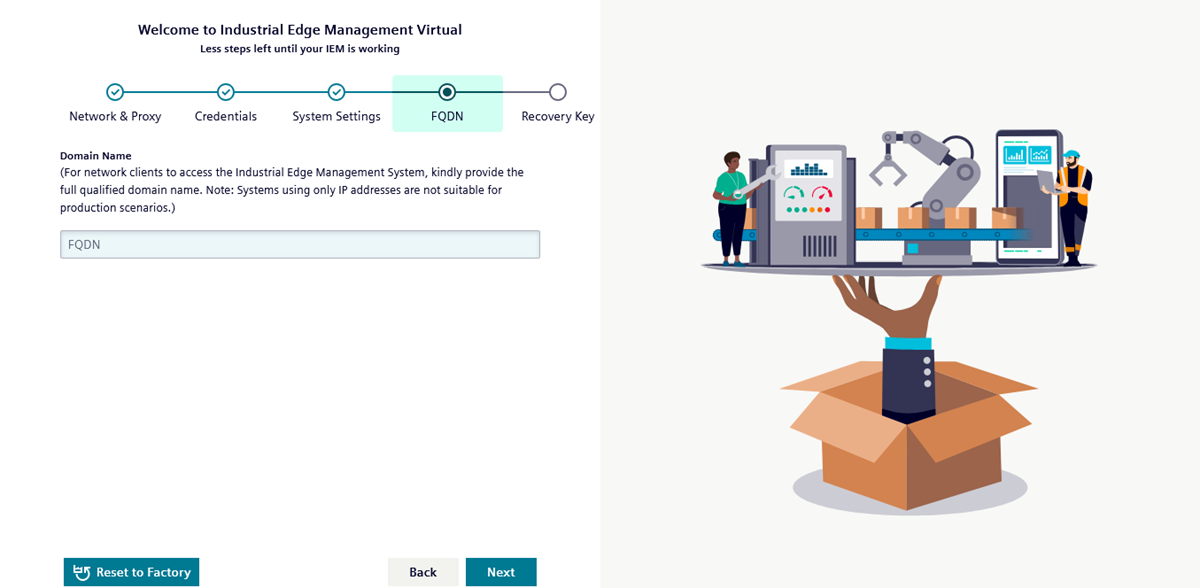
Cannot be changed
The "Fully Qualified Domain Name" field cannot be changed at a later point in time.
-
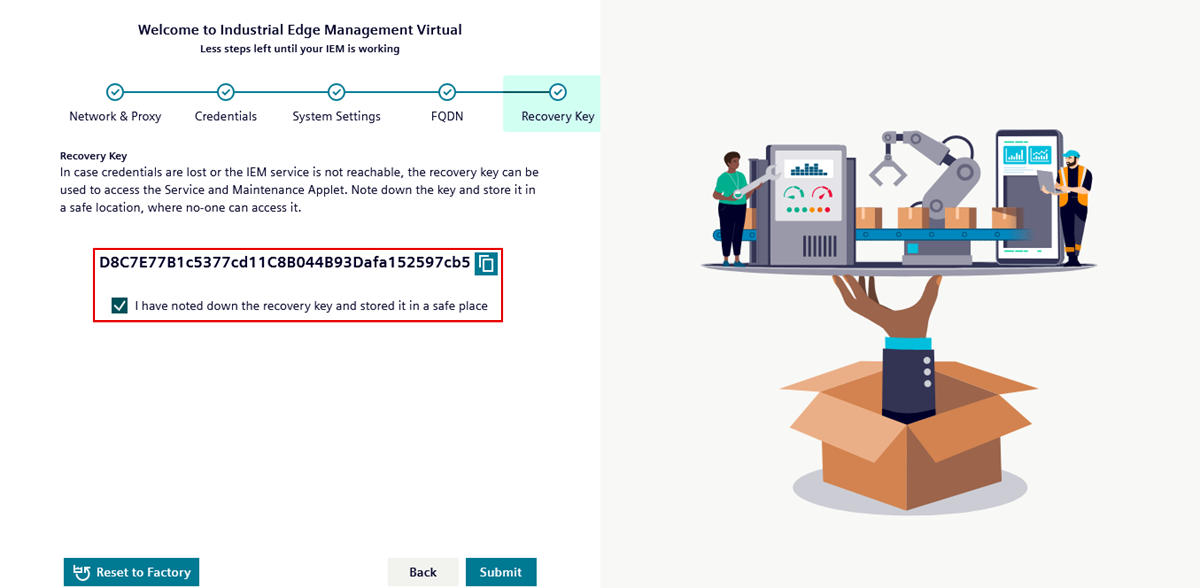
Click "Next". The "Recovery Key" page of the setup wizard opens.
- Recovering or resetting IEM Virtual requires the recovery key. Note the recovery key down or store it in your password manager.
-
Click the checkbox to confirm that you have noted down the recovery key and saved it in a safe place.
-
Click "Submit" to transfer your settings. The deployment process starts.
-
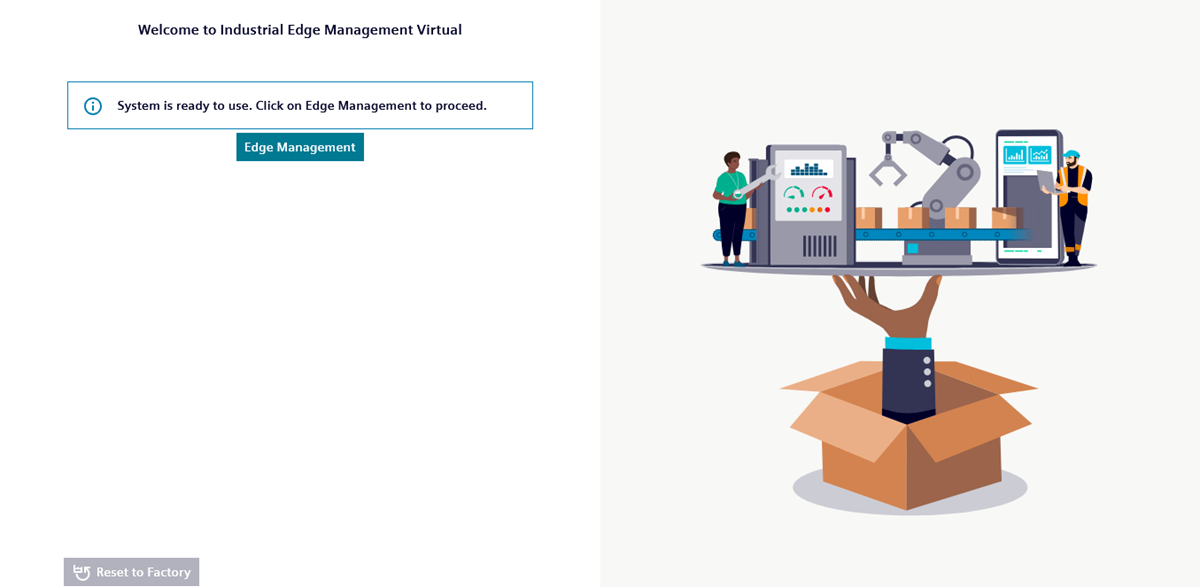
The setup wizard displays "System is ready to use. Click on Edge Management to proceed." when the deployment process is complete.
-
Click "Edge Management". The Industrial Edge Management login screen opens.
-
Enter the username and password assigned during setup.
Validating the outcome for IEM Virtual
After entering your username and password, the IEM user interface opens. This means that you have successfully set up your IEM.
Proceed to What's next?.
What's next?
After setting up your IEM instance, proceed to Choosing your Industrial Edge Device.